This morning I've been re-listening to that little ray of sunshine himself, Bonnie 'Prince' Billy. He's such a cheery lyricist. Songs such as Another Day Full Of Dread, Today I Was An Evil One and of course I See A Darkness make up this sunny and light album. One of my absolute favourites on it, however, is Death To Everyone:
I am here/right here/where god puts none asunder/and you/in black dress and black shoe/you do/invite me under
One of the hardest things about grief, I think, is the insidiousness of it, the way it filters into every atom, every fissure of your life. How it creeps up on you when you least expect it. Making a cup of tea, the radio on, one minute you're singing along, the next you're on the floor doubled over. What happened? Perhap it was a line of a song, perhaps, just a word. Maybe it was the way your spoon clinked in your cup as you stirred in the sugar. Maybe it was noticing that picture that wasn't hanging straight on your wall and adjusting it, suddenly you find yourself staring at it, lost in its image.
It is a hard process to understand in oneself, because it is sometimes so unpredictable and apparently illogical. For me, there can be several weeks where it follows me everywhere I go, it's that black dog I simply can't shake off. Then eventually I emerge, new again, still alive, still whole, still able to smile, perhaps smiling even more. Other times I can go in and out of it on a daily, even hourly basis, one minute writing out some plan for my life, preparing an application form, the next, I am inconsolable, unable to lift a pen.
It is perhaps even harder to understand in another person sometimes. And the thing about grieving is that the only thing you can do really is carry on, is to get on with life, because you need the straight and narrow to keep to whilst your world falls apart, it's the concrete and the road signs that keep your nerve steady and your feet moving when there's a tornado tearing through all the land around you which you once called your home.
You keep looking ahead, eyes on the next step forward. And when you come across a patch of meadow that hasn't been hit you say "hey, look at those daisies, look at those buttercups, aren't they beautiful!". And they are, and you do really see it, you really can smell the grass and the earth beneath it. Sometimes it can feel like the first time you've seen a flower at all, it is that beautiful. In that moment there is joy, so much joy to realise the grass is still growing and the flowers are still blooming somewhere, and that they all look so perfect and smell so good, even if you know that's your house over there in the distance, and it's burning to the ground.
However, the thing about getting on with life when you are grieving is that people can then believe you're ok. Of course, they want to believe that, we all do, because grief is unpleasant for everybody, even if it's not your own loss, it still brings a chill to the heart of an otherwise sunny day, it still reminds you of your own mortality, it is the cold clammy truth none of us particularly want to know about on a consistent basis. Unless it's thrust on us, of course. But when you are grieving, it is all you know. It is all you think about. It paints every aspect of your world with it's own particular colour. Life, death, ageing, sickness, beginning, ending, birth, loss, love, suffering.. questions, questions, always questions that you can never stop asking and yet must learn to live with the unsatisfactoriness of the fact that no answer can really provide you with the solace you long for.
So when you cannot yourself run away from the truth of loss, when it is right in your face, you also realise that others can run away, that they have an option which you do not. And so, on some level they cannot access with such intensity what you youself can at this time, and that, right now, every day, they are creating and building worlds just as yours are constantly being torn down. You realise that on some level, at the end of the day, at a time when you most acutely want and need kinship and understanding as if it were air, you will be, at times, most profoundly alone.
This has been a strong realisation for me, and it's helped me grow up a lot. It's also been hard. And people are there when they can be, and some people close that gap as much as any caring person can, and it's a beautiful thing when they do. And somehow, in the times when people can't, you learn to find a way to live with that gap of experience, and not blame, and not blame yourself.
However, last year I had to let go of several people I thought were and would always be the closest people in my life because for whatever their reasons, they didn't have it in them to meet me even a tiny bit of the way in trying to understand what it must be like to be losing a parent. And that hurt. There hopefully aren't that many times in one's life when one has to hold up one's hands and call on friends and loved ones to rally round a bit -and it's hard not to feel let down when that does not happen, and people even turn away from you. I'm still working on that one.
Grief does its work on so many levels, it leaves nothing unturned, on the one hand it draws out and burns up what is not true, what is bullshit, what is fantasy, what is not good for us, what needs to go. It shows up what is weak, superficial or selfish and it highlights what is strong, what is deep, what is loving. On the other, it brings forth a demon of rage and bitterness and an unforgiving pain that will not be pacified, that does not want to understand the complexity of human foibles, only it's own need for solace. For me, I struggle to work out which is which, and what I can realistically expect from people, and that struggle is part of the complexity of my grief.
We all go to places no one else can go at times in our lives, over and over again. There are things about every single person on this planet that no one else will ever know or understand. We stand alone. And yet we cannot survive without human love. These two will hold hands in a clasp of contradiction forever.
And I wouldn't give up those moments when I realise I'm really ok being alone in darker places, I'm really ok that no one else knows all that I am keeping inside. What would the world be without its secrets? And somewhere, out there, there is always someone who has shared your experience. Because whether we realise it or not, ultimately we're all in the same shoes, heading in the same direction, coming from the same homeland. And it's a place of fire and flowers, meadows, whirlwinds, the scorched thatch and the long, long road.
I'm slowly learning to draw a circle around me, I guess you could call it a sacred circle, one that honours and cherishes that space where no one else but I can go, that lights a candle and sings softly in devotion to those darkest, loneliest hours. And to remember that there is still love over the other side of the line, sometimes imperfect, messy love, but love nonetheless. And I am not perfect, and I cannot always do the best thing, and I get upset, and I get bitter, and sometimes I flail and I rail, stumble about, and I can't always forgive others' shortcomings, and I can't always understand or even be reasonable, because I've been losing the most precious person in my life for some time now, and death isn't doing it's work kindly, and loss is a peculiar, devastating thing, and when any person deeply touches it, it is a fire in the hearth from which they cannot remove their hand, until gradually, eventually, with the passing of time, its flames die out.
So strap me on/and raise me high/cause buddy I'm not/afraid to die/cause life/is long/and it's tremendous/and we're glad/that you're here with us/
death to me/and death to you/tell me what else can we/do die do/death to all/and death to each/our own god-bottle/s'within reach..
Monday, January 08, 2007


Wednesday, January 03, 2007
Happy New Year
Well, it's a new year and there is much to recount of the last few weeks or more of my life, much to divulge of the inner workings of my mind and soul, and many outpourings of my imagination to offer up to you all.
And of course there was Christmas, with it's strange Midnight Mass and an abundance of gingerbread and chocolate bishops, with its beautiful and sometimes difficult workings out of family love and loss, a silent New Year's Eve and my three day excursion to a fishing village by the sea in deepest darkest Yorkshire to meet with the rugged elements and a certain boyo's family.
But all this must wait, for there are more important things afoot.
Yes, Celebrity Big Brother is back! I've just finished watching it and it is as disturbing and as ludicrous as ever. Eleven 'famous' housemates have all entered the Big Bro house tonight and are now awkwardly sipping tea and failing to recognise who each other are at this very moment as I write. Yes, there are the usual boring characters - a beautiful Bollywood actress whom nobody's heard of over here, then there's Denise Somebody Or Other, whose main claim to fame is that she got kicked off the Miss United Kingdom throne of honour upon winning first prize ater it was discovered she was shagging one of the judges (who happened to be Teddy Sherringham).
However, the person I was most shocked to see in there was Ken Russell, God forbid, who took to the celebrity runway from his blacked out car with a bright red face and multi-coloured waistcoat, acting like someone on day release from the local Alzheimers' ward. He staggered along shouting gibberish at the crowd in what looked like some kind of attempt at being wacky or way out, which unfortunately just left him looking like a grey haired puffy faced old man version of most of his films - unpleasant, tedious and somewhat distasteful.
The same kind of went for Leo Sayer, who bounced his way through the crowds like a demented troll, huge white teeth flashing up at every camera. And my God, he doesn't look any different from how he did in the Seventies, and he is just as irritating in the flesh as one might suspect from hearing his songs.
The entrance of Danny Tourette, mulleted blonde haired singer from rock/'punk' band the Towers Of London looked promising as he staggered pissed out of his head up the red carpet shouting "Fuck you all!" to the entire crowd and showing them his skinny torn denimed behind. Though it was even better when he entered the house and the only person he happened to know there was Leo Sayer. "Leo!" he cried as the midget frizzy haired 70's popster swung Donny into an embrace and squealled "How're you doing boy? Berkshire, isn't it, where you're from, how's it all going there?".
But the total highlight of the evening was the final entrance, from Dirk Benedict. At this point in the proceedings he is very much my tipped favourite. He emerged from the back of a van with a huge cigar, beaming at the crowd before turning back to the van and shouting into the backseat "B.A., I'll be back soon!". Yes, it was none other than Face off the A - Team, now a middle aged screwball with an overnight bag filled only with cigars and whisky, who hates groups and team work, and who is single and wants to find a nice woman in there who isn't the age "of my daughter". Fantastic! He got a hero's reception, and quite rightly too.
It apppears that Big Brother hasn't sold itself short on the mix of B-List Celebrities and old has-been former stars, whilst throwing in a good measure of bimbos and ex boy/girl band members for good luck. And they all appear to be as mad as a bag of spanners. But adding Ken Russell is a touch of brilliance, and Dirk Benedict just perfect. Let's hope by the end of the evening everyone has worked out who Jermaine Jackson is, with his sequined jacket and shiny plasticised face, before he has to tell them.
Tuesday, December 05, 2006
Where have all the libertines Gone..?
There are times, like tonight, when I do not smile upon my physical form, I do not take comfort from my shape and my softness. It took me a good ten years of being on this planet before I could even get my head around being a girl at all, and even then it felt like a strange act to put on in so many ways.
And yet, I remember staring at myself in a mirror whilst on summer holiday one year, at my cropped hair, my thick boy's shirt, my gangly shoes. And I took a straw hat from a stand and put it on my head, cocked it to one side and narrowed my eyes the way I had seen those stars of American Seventies films do when they were being meaningful and sexy. I wanted to look like a film star, I wanted to pout and to seduce the way they did, and from that time on, I would sit in the back of our family car whilst my Mum stared ahead driving, looking out of the car window in a dreamy, deep, dramatic way, my eyes again narrowing in film star pose, as I imagined a secret camera filming me rolling through the streets of Hawarden, up Bennett's Lane, under the bridge where I would hold my breath for good luck, past the nuns playing their recorders in the Convent garden and up our long drive that led to home. In those moments I was all of Charlie's Angels. I was Daisy Duke. I was Wonder Woman.
But I never could imagine becoming Wonder Woman in reality, with her dynamic basque and erotic hotpants, her large, powerful breasts, her lassoo. Instead, I felt more inherently like I was Dangermouse. Or perhaps a kind of hybrid of Carry On characters (my favourite films growing up)- a bit of Charles Hawtrey crossed with Hattie Jacques, a liberal dose of Kenneth Williams morphing into the cackle of Sid james. So on the inside I felt more like these, but at the same time desperately wanted to be Wonder Woman, or better, one of those dancers in the Kenny Everett Show, Hot Gossip, who wore very little, and whom my mother would try and ban us from watching whenever the programme came on.
Maybe I still felt more like Dangermouse when I finally lost my virginity at sixteen. I would wear basques and frilly black knickers and stockings, because that was what I thought was meant to be sexy, what my boyfriend thought was meant to be sexy. But I always felt too flat chested, too girlish to pull off seduction, not yet in either my body or my sexual power to get anywhere close to understanding what all this meant. And it took me years to realise that what was meant to be sexy would never be sexy as long as it stayed in the realm of what was 'the done thing'. 'The done thing', largely, in my experience of the world of sex throughout my teens and early twenties (despite trying to pass itself off as wildness and experimentaton), seemed largely to consist of disembodied people (myself included), committing disembodied acts with each other, being shown disembodied sexuality in film and magazines (meant to be a turn on), whilst living in a largely disembodied bigger sexual culture.
And of course, in a culture like this, in a mind set like this, nothing is really sexy. And I thought it was me, that there was somehing wrong with me. Or with my partner perhaps. But I realise now that it was nothing more than a symptom of being young and inexperienced in a culture where we read Page Three with our cuppa, where pornography = the death of the Imagination on all levels, and women are brought up to believe that lacy thongs from Knickerbox are what makes her a desirable woman.
I no longer feel like Dangermouse. Though in fact, I wouldn't be too disturbed if I found myself feeling like that in a moment of arousal, who knows, it could be quite sexy. But I do find sex as it is presented in our culture, possibly one of it's most tedious and banal shortcomings. Sexual consumption and artifice seem to be what is peddled daily by our media and sex industry. Perversion and kinkiness yawn at us from every street corner (and that's just the billboards). Jesus, hasn't anyone cottoned on yet that the breaking of sexual taboos has become just the latest form of conformity? That every man, woman, transgendered person and their dog has probably done fetishism in some form, no matter how slight, and it doesn't need to be rammed down our throats (excuse the turn of phrase) at every opportunity in order to sell a new perfume, promote the latest facile pop act, sell a few more million newsapers that aren't, in reality, fit for us to wipe our bums on.
I digress. I want a new sexual thrill. An extremity no one has ever dared to peek inside before. And I'm not talking nailing my nipples to a wooden post, or hanging by my toenails from the chest of Pamela Anderson. Jesus, my life is filled enough of that stuff anyway in the real world, never mind in a fantasy one (metaphorically speaking, of course). No, this thrill would come from the society around me. Just give me something pulsing with aliveness, something articulate and meaningful and born of the stuff that life, growth, decay and death are made of. Just spare me the alienation and manipulation and exploitation, the dead dog that tries to pass itself off as sexual consciousness in our society. Then I might just get a thrill, I might just feel even a flicker of interest in what our culture wants me to get turned on about. And this is not some feminist plea, god save me from that. It is simply a desperate, fed up call, away from the superficiality and crippling blandness of mass sexual consumerism, towards life force, imagination and, dare I say it, soul. Whether that soul is as clear as the sun up in the bluest of skies, or whether it is a blackened, twisted thing of many contours and many lonely lanes. Whether it is made of perspex or rubber or tin. Whether it is a violence of sound, or makes the tiniest whisper in the morning. Perversion and fetishism was always a means of contacting the deeper, darker, powerful forces of life and death, of subverting tired norms. It saddens me that now it just seems like any other episode of Hollyoaks.
I can fill a bra and pair of stockings these days. I might even look pretty good in those gold hotpants. But that doesn't really do it much for me tonight. Tonight I feel more like an 18th century boy, hat in hand, my shirt open to my belly button, the material of my trousers caressing my slim hips, my toes pale and dirty. And I'm looking for a house where I can take myself and my longings, and it's not in this country, it's not in this century and it's not here.
N.B. any cheap, stupid or obscene comments made on this post will be immediately deleted unless of course they are made by my boyfriend.
Sunday, November 26, 2006
Pogli
When I was in Darjeeling eight years ago, I stayed with a woman of 60 years or so who went by the name of Mrs Ongel. She had a penchant for poker and Padmasambhava, with dark eyes that curled up at the edges when she was concentrating on winning a game, and that danced with laughter when she played with her young granddaughter, Tara.
One evening, as my boyfriend and I wound our way through the narrow streets of Darjeeling back to Mrs Ongel's, we came across a strange woman with jet black dishevelled hair and a rather crazed look in her eye who was sweeping the cobbled street with a fervour I had never before seen devoted to such a job.
The next morning at Mrs Ongel's, as she shuffled her cards and offered us tea, we mentioned the woman, commenting on how unusual it was to see a woman doing such a traditionally male job, (it seemed rare for that to happen in Nepal at that time), and so late into the evening. Mrs Ongel just smiled and said "Ah, that is Pogli. That is not how she makes her living, that is just what she does, you know, for the sake of it. Because she is, well, pogli."
I mulled this over.
"Pogli?" I re-iterated.
"Yes," smiled Mrs Ongel, "We call her Pogli because that is what she is, you know, p..o..g..l..i..". As she mouthed the word slowly, she started making hand gestures, pointing her forefinger at the side of her head and circling it rapidly. In the end, we got it: Pogli was someone who, in Mrs Ongel's mind was off the rails, a bit crazy, 'got a screw loose'. Her hands flapped in the air.
I never forgot this, nor did I forget my time at Mrs Ongel's, with her gambling ways and her serious devotion to Tantric practice. For the rest of the trip, and upon my return to England, indeed for all the subsequent time since then, the word pogli, or poglie, as I sometimes spell it (for I have no real idea of how it is spelt or even if Mrs Ongel's explanation of the term or indeed my interpretation of her description was correct), has become a significant word in my own personal dictionary, a mainstay of my communication, somehow filtering into my language and descriptions.
And so I have, for my own purposes, adapted this word to describe a state of being that I have never before had words for, and desperately wanted a term to describe: that is, something or somebody: it could be a moment, a behaviour or an action, it could be a way of thinking, it could be a place, or even an object, that is inherently, indefatigably, eccentric, odd, unusual, silly, strange or not able to fit into conventional society or experience. And, to put my slant on it further, that, in its eccentricity, is undeniably charming, endearing and life-affirming. To me, that is pogli. And so I have incorporated and re-framed this word, frankly, because I see and experience so much in this world and life that is frankly, pogli beyond belief, and that otherwise,I have no language for.
In fact, in my own purloining of this word, I would not only put the black haired obsessive compulsive street sweeper of Darjeeling into this bracket, but also Mrs Ongel (her name can be translated as Mrs Angel for heaven's sake), and no doubt myself at the time, working my way, as I was, through some of the holiest places on the planet, attempting to track down the elusive Dzogchen master Chatral Sangye Dorje, sitting in caves waiting for an emanation of Guru Rinpoche to appear, attempting to practise shooting my consciousness out through the top of my head with about 500 other Tibetan monks and lay people on retreat, throwing up on a regular basis and reading too much William Blake. In fact, I would go as far as to say, that, though all countries undoubtedly have their aspects of pogliness, if pogli is a throne at which the powers of the strange and wonderful and occasionally bananas sit, India must surely be its queen.
So there we have it, the power of the pogli.
So I explain this so as to be able to say to you: yesterday was a pogli day. I first realised it was going to be pogli when I woke up in the morning and remembered my dream. In it, I was living alone in a tumble down version of my old family home, the only other memorable item in my house being an old and bent metal framed pair of spectacles which belonged to Karl Marx. They hung inconspicously and somewhat sadly on my lounge wall. And somewhere, in a distant room, the ghostly image of Marx's grandson floated above the carpet, himself now sixty, with a large belly and paunchy face, having convulsions, as he sweated and and struggled to breathe on a white table. Outside the house, reporters gathered, and I discovered through reading a newspaper that years ago my father had bought a Faberge egg which was now worth 30 million pounds, and it was still somewhere in the house. But I couldn't be bothered to look for it.
So when I drove up the Upper Lewes Road, that morning, and spotted not just one, but four identical pairs of black converse boots suspended mid air from their laces from the middle of the telephone wire, 50 foot above the road, I was starting to feel that the power of the pogli might be with me that day.
We then stopped off at Sainsbury's, for my companion to buy a box of Celyon tea and several packets of hobnob biscuits (the ones with vanilla and chocolate cream in the centre), to which he seems to be firmly addicted (he keeps them in a rather impressive biscuit barrel, and when I noticed he had attached with sellotape a paper sign on the lid asking: what is it you really want?, I asked him if this worked as a deterrent, he replied, " No, I just realised that what I really wanted was biscuits"). Approaching the supermarket, I then noticed that the Welcome sign on the side of the building had been altered by somebody, and now read: hell: we bury ewe.
This significantly cheered me up, as it was, early on a Saturday morning, and I still felt like I should be tucked up in bed dreaming, whether it was of Marx's spectacles or not. I then sat in the car and listened, whilst my companion searched for hobnobs, to a radio programme about the National Lying Festival, held in Cumbria, in which men and women compete for the title of the best fibber in the land. Apparently it all began out of the tales that locals would regale visitors to their region with, and, who, usually upper class, with a naive and patronising view of the 'backward' yokels, would believe every ridiculous story spun them. And so, to poke more fun at their guests, the locals' tales got more and more silly and improbable, as the visitors would shift uncomfortably in their pub seats over an ale, trying to work out, puzzled looks on their faces, who the real stupid one sitting at the table was.
We then drove through the rain to my companion's house to take it in turns to stand for the rest of the day on a wobbly plank that we slid into one large ladder and one small ladder at each end, twenty foot in the air, in an attempt to paint his stairwell three different shades of cream, whilst he took regular flights towards the kitchen to make another cup of tea, and towards the living room to grab his banjo and, break, spontaneously and wonderfully into exhuberant twangs and twiddles of fine banjo music.
Upon returning to my flat on the evening, I was visited by the Bob, and, well, frankly, that requires no explanation as to how or why that might have been somewhat pogli, given that Bob just is pogliness personified, at least in moments that come with delightful frequency (he recently invented a blog called the that bloke's bike's back brake block's broke blog).
I mean, really, the whole world is pogli, we all know that: it just pretends it isn't. And this is a world I want to live in, a world where people hang shoes from telephone wires, and hold Lying Competitions and play the banjo when they are supposed to be doing up their house. Where there is room for women who sweep the streets for its own sake, and, though they might get a little teased for it, are accepted as part of society, and regarded with affection. Where people devote serious time and energy to cataloguing the minutiae of birdsong, and a girl with wonky specs writes for far longer than her arms are happy with, about stuff and nonsense, lost in memories of India and Nepal, and fleeting angels, lost gurus, and tumbledown buildings where men in smocks blow horns making ridiculous sounds, and mantras of devotion are chanted over and over and over again to the spirit of some ragged and beautiful, absurd truth.
Tuesday, November 21, 2006
Catch-Up
I spent yesterday afternoon in bed with a hot water bottle and my toy dog, nursing a sore and menstrual belly. I took this time to slip in and out of the waking world to the sound of Joanna Newsom's new album Ys, her follow up to The Milk Eyed Mender .
To me, Joanna Newsom's songs transcend time and space, slipping between this world and all those others which spin together in this incredible and mysterious universe we call ours. And her voice is amazing, somehow sounding both direct and a thousand places at the same time, ageing and ageless. At some points she sounds no more than five years old, at others, she is a mature woman with lines creeping upon her face. Sometimes I can hear her at eighty five, others, she is a voice beyond all time, rattling down the centuries. She weaves her melodies through the cracks of existence and takes us with her down deep into the grass with the insects and the dew, humming across the sea bed to the tops of shipwrecks, spinning dark energy from her fingers, hanging from the corners of stars as she shouts entire verses about meteors and wheelbarrows and I am flabbergasted, left with huge tears in my eyes.
I love it when song can do this to me, when I am a balloon filling with vowels and consonants, crescendos and cadences. When it takes me to those worlds I always longed to go to, or that have become some distant memory, buried deep in the back wall of my being, or even that I never knew existed. When I listen to albums such as Ys, I know it can hold me, in anything, in the same way that a mountain or a wide green open field can, and that reminds me of the immense power that potentially lies in music and in words.
I felt similarly when I watched David Attenborough's Planet Earth last Sunday night on television. This is an extraordinary series, I never fail to be dazzled by the cinematography of this programme, as it tracks the natural world in all it's beauty and complexities. On Sunday, it was about jungles, from the tops of the tallest trees to a man who sat 300 hours alone in a hide in order to catch just a few shots of three birds of paradise performing their mating dances. From colugos, strange squirrel-like creatures that glide through the air from tree to tree by flaps of skin which attach, bat-like, from their bodies to their furry arms, to raiding chimpanzees, capturing and killing a rival member of a tribe, passing its bodily parts and head around to be eaten. It travels from the most impressive, beatific sights in nature to the most horrific, from the vastest to the tiniest all over the world. At one point it filmed a clearing in a jungle over the period of one year, but speeding the film up to show it all in a few minutes. It was clear from watching how these plant forms were growing and moving, how intelligent all forms of life are, as they travel and expand to the tune of their own logic and sense of instinctual survival. Seeds and pods burst to bud, to stalk and to vine, find their way across fallen trunks, scaling trees, climbing towards life and light. The plant kingdom is an entire universe in itself, governed by its own laws and logic.
For much of existence in the world, we humans are utterly insignificant save for the harm or good we inflict on them or their habitat. The animals go about life their way, the insects are indifferent to our desires or our dreams, plants and fish travel through their universes as we travel through ours. The toad belches and sings his way through the night, and it is his night, just as the child clutches his blanket and stares wide eyed and white faced at the shadows thrown by the cupboard door, and his world and the frog's world are as real as any I can muster. A flower knows how to court the bees and feed from the forest. The spider always knows the best way for a spider to be.
I wish I had a great mind for science and logic, I would love to study biology and geology, physics and maths. But my brain is as slow as a tortoise up Mount Everest at such things, stubbornly refusing facts and figures into its depths, preferring always the poetry and images that they conjure, the skew-wiff angle, the endless unravelling, the bits that escape definition, the non-rational, intuitive. Give me Derrida, I'll lap him up with a big spoon. Give me quantum physics and I'm there for five hundred years scratching my head to understand just three words, (despite the fact that I don't see a world of difference between quantum physics and deconstruction in the first place). So I'll refrain from saying something deep and meaningful in a factual way about the universe here now, despite feeling like this post needs it right now. Maybe I can leave that to the beloved Bob, who is currently residing in a tiny caravan alone in a wood somewhere in Sussex, probably eating RicePots and working out another law of the universe as I speak, and who blows my mind about such matters on a regular basis.
Well, it's been such a while since I last posted, so I might have known this would end up a long ramble. And I haven't even recounted all that has happened since I've been away. Suffice to say, I've been favouring music over writing for the last few weeks, hence my absence here, and it's been a productive time in that respect. I've recorded five of my songs for a demo with the help of the lovely Tom, who, aswell as being a dear friend, is also a wonderful songwriter and a talented musician. I've also been teaming up with others to collaborate and jam and things feel exciting for me musically at the moment.
Other things I've been up to recently: poetry submissions, being skint, sobbing daily at The Jeremy Kyle Show (move over Pete Doherty, he's my new hero), my acting debut as a grieving pale faced, black dressed sister who turns into a chiwauwa in Tony's new short and very weird (and good) film, previewed at the Duke of York's on Saturday. Eating lots of Turkish Delight and discovering the Choccywoccydoodah cafe (we're talking a piece of cake the size of your head, a cafe equivalent of an opium den), realising at 33 and a size 14, I'm never going to make it as a Supermodel, not cleaning my flat, loving, mourning, feeling romantic, occasionally reading and falling off my bicycle.
That should do for now.
Saturday, November 04, 2006
Constanza and The Nun

Ever since watching a programme about it last Friday, I can't stop thinking about Gianlorenzo Bernini and his sculpture The Ecstasy Of St Theresa. I feel haunted. In the most transient moments - sipping a cup of tea, throwing a bag over my shoulder to go out the door, turning over in my bed in the early morning, slicing potatoes on my plate, I see the image of St Theresa's enraptured face, turned upwards, her mouth open, the fine point of an arrow entering her, a spray of golden light behind, her robe in swathes around her like liquid sunshine.
It is almost a cliche now to talk of the greatest art as being created by the most messed up people. And true, there is much powerful art that is, and has, been created by men and women where neither mental illness nor egomania is the driving force. But equally as true, genius springs from what is incomplete, flawed, sordid, neurotic, stupid, disparate and ugly. From the gutters of despair, in the midst of crashing disillusion, loss, sorrow, hatred and violence (I wonder if life itself is only as beautiful as its own despair, only as pure as its worst filth, only as strong as the weakest, most despised runt of the litter).
I think of this when I look at the Ecstasy Of St Theresa, and when I remember Bernini's torrid life story, and his dramatic depiction of this woman, a holy woman, and, in particular, of her physicality, her face and body as the meeting place or conduit for divine revelation and bliss.
I think a woman's body, in all its variations, is to me one of the most beautiful forms there is on this planet. It is one which has been, and still is the site of devotion, adoration, violation, reverence, contempt and horror in our world. Exalted, degraded, ridiculed, feared, controlled, desired in a million different ways, a woman's body is as complex as life itself, as death, as dying, as growth and decay, as desire, wanting and repugnance.
Sitting here now, under my clothes, I can feel the skin of this body that I breathe through, I can sense the blood circulating my veins, hear my heart beating in my ear if I press it to my shoulder. My breasts, my hips and vagina, my neck, legs, skin, hair, eyes, buttocks, feet, my back are all realities in and of themselves, but they're also the vehicle for a thousand different projections, some dazzling, some shimmering, some comforting, some lit up in the crudest red light or beset by howling laughter.
Some of these have been handed down to me through time, some are of my era, some through art, through philosophy, religion, culture, literature. Some are inside my own head, most surround me from the outside, from the voices of men, from the voices of women talking to men, from the voices of women who do not care what men have to say. From my mother, from my father.
Am I ever my own woman, I ask myself, can I ever escape this hall of mirrors, know my body beyond its own symbols?
I think of it split and ripped by giving birth, a cell multiplying inside it, growing into foetus, forming, enlarging, holding the blueprint for its own destiny, forming hands and feet, a nose, a throat. A life being born - my body as toil, violent music playing through a crackling stereo. A child moving through me, pushed out by labour and agony through the birth canal, ripped from my flesh, out into cold open air. The uncut umbilical cord, the bloody placenta.
Inside and through this female body, life is formed and grown and expelled with massive effort and incredible physical, mental and emotional intensity. And this intensity, this force and power is there, whether realised or not, in every single woman as part of her physical being.
To me, this force inside a woman is beautiful, and messy. It is complex and it is also the simplest force in the world. A force not different from that of the uncovered grave, a corpse peeping out at us from under the soil. Or from a puja on the Ganges, in a blazing light of candles. Or the baby floating past, its head, a bloated shrine. Its skin, grey.
And yes, it is The Ecstasy Of St Theresa, hovering in the air. But it is also Bernini, the artist who carved it, a year before its conception, sunk to the floor, a nobody, a nothing, the memory of the failure of his greatest architectural ambition ringing in his ears.
As it is the epilieptic nun, scissoring in divine rapture across the wooden floor, eyes rolling in the back of her head. She is not pretty. She is not even beautiful. Only a coarse woollen robe, two pairs of old hands holding her spindled tattered frame in the sunlight that pours through the stained convent windows, too bright to bear without her palm across her face.
And this same force is also Bernini's illicit lover, Constanza, in marble, the loop of her cotton blouse pulled slightly undone, her eyes like wildfire in a forest at night, or a tiger esaped from the zoo, once leashed and captive, now, more than untamed: out of control, hunting, hunting down.
And it is Bernini's servant with a sword, slashing at Constanza's face in retribution until it is ribbons, the pillow soaked in her blood, the colour of her most beautiful dress, of her lust. She will never again have a face that can be immortalised in sculpture. The Muse becomes damaged goods, fallen from ecstatic grace, imprisoned for fornication, disfigured.
So it is Constanza who pays the greatest price for passion, and after nearly killing his own brother and scarring her face for life, the real perpetrator goes free: Bernini, the great hero of Rome becomes an even greater hero, the great hypocrite, scoundrel, egomaniacal amour, liar, destroys and violates in the name of love all that he once created and revered as beautiful, as divine. This woman who was his Muse, who became marble, who fired one of the greatest sculptors in history's world with a blaze of signifiers. Who torched it all with her own betrayal. Whom he will never want again. Whom he will never again watch sleeping through the night, holding his breath lightly so as not to wake her. Whom he will never long to press her small head into his chest as though she were his own restless child.
And now her face is a map of stars, all traced in blood, her honour a withered flower, her wildfire burnt out beyond all reason. Where is left for the woman to go? At Bernini's command she is again caged, this time in a damp prison cell without light, in rags and humiliation, taught the lesson that all women who play with fire must learn in 17th century civilisation, the image of her passion, her beauty, her womanhood, consigned to a sunless locked vault.
This same man conceived and gave birth to the remarkable, transcendent Ecstasy Of St Theresa, long after the light had left his eye, long after such tragedy and violence, after his own sudden descent into failure and his turning to God. And this same woman, Constanza, also gave birth to it, and is enfolded within the creases of St Theresa's robes, in the openness of her mouth, her half closed eyes, though almost certainly neither she or Bernini will have ever known, will ever know this.
Woman, Muse, sister, daughter, mother, virgin, slut, truth, beauty, warfare, corruption, fertility, deceit, the earth, the stars, the moon, the fields, the tether, the breaking of all mundane bonds, the higher, the lower, animal, angel, divinity, a flower, a rose, the scent of death...these words and images haunt me, as the Ecstasy Of St Theresa haunts me, as Constanza and the nun haunt me, as a woman who, like every other woman, is all of these things, who is Constanza and St Theresa, Bernini and the ecstasy itself, and, who, in the middle of the night, or when sipping tea, or throwing a bag over her shoulder to go out of the door, slicing potatoes, is none of them, never has been, and never will.
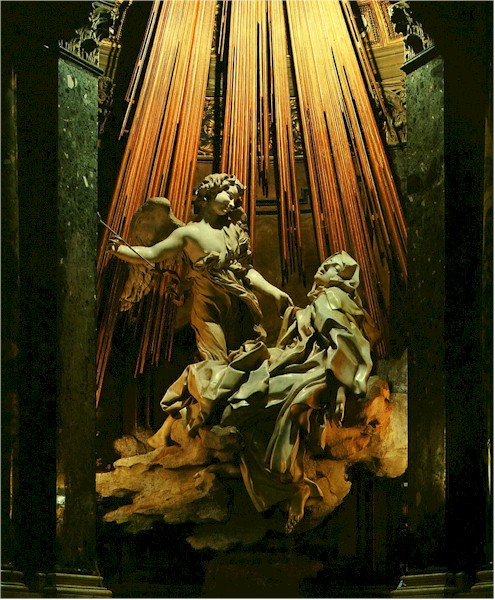
(top image: 'Eve', Rodin's studio, 'Cain' in background.)
Sunday, October 29, 2006
Nunhead Cemetery
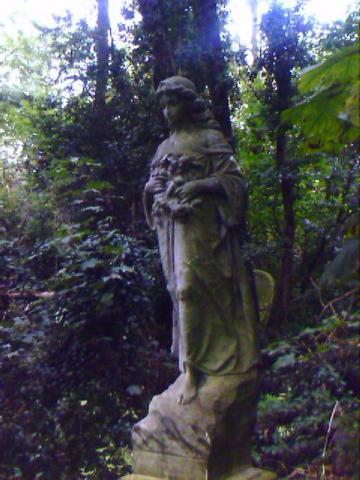
Four o' clock. The iron gates close at five and this is not the kind of place you want to spend the night in. My sister and I hurry up the gravel path, then stop suddenly to speak about our mother, taking it in turns to empty our hearts, spill our grief, hear the brown leaves crackle underfoot.
We walk up to the ruined church, without a priest or congregation, without stained glass or sermon. No hymn book. No bride. Only our two sad faces peering up into the light, past the crumbling pale stone, no longer seeking the holiness of perfection, instead loving the ruins of beauty, perfect in themselves.
And so we wander this way, wander that way, speaking in staccato through leafy alley ways, past grey tombs and mighty obelisks, under huge trees heavy with ivy, graves hidden in the bracken, overturned headstones, fallen angels with broken wings sliding, sliding into mud.
We stumble down a narrow dark tunnel of green, and there, in the squelch of mud, we speak our truth of grief and fear and losing, say things rarely spoken of life, except at times like these. Names and dates, old and young, men and women, loved and unloved, all pass through our unlit eyes.
To my right, an ancient tree is being lifted into the air by a cracked headstone which has subsided and moulded itself into its thick roots. My sister turns, spots a marble casket, its lid open some inches, sliding off. The blackness inside stares back at us like an unflinching eye.
We stagger out into daylight and a damp grassy glade filled with the graves of wives and mothers, plastic flowers in psychedelic colours in plastic pots dotting the horizon. And there, around the fresh churned soil of a newly dug grave, jump seven magpies, and a red fox, darting, moving.
I feel like we are intruders in this scene. The grass is all lit up, the trees are bowing. A strange current of silence is in the air. The grass is blowing. For this is their world, their language, of brightness and burial, tender woodland and no return.
The fox looks up and stares at us carefully, turns tail and leaves. The magpies scatter and disappear, and we are left alone once again in the singing daylight with only the trees, the dead and the ravens, and some distant echo.
We leave the gates of the cemetery. Back on the high street, I feel as though I am emerging from a murmured spell, a remarkable tune running through my head.
Saturday, October 21, 2006
Next to the Angel Peace Statue at the point where Brighton turns into Hove, there was a huge crane towering over the seafront, looming tall next to Embassy Court. I wondered what it was for, with a metal grill box hanging from it, and I could just about make out the outline of two men. Suddenly a figure of a man jumped from the box and was dangling before my eyes attached by a white rope around his ankle.
I stood and watched as he was lowered back down and another man took his place in the metal grill box, and was lifted back high in the air.
Today the sea front is so alive with such sights, I feel almost airborne. Huge swathes of starlings line every inch of the West Pier, and seagulls float above me, immobile in the wind. Black silhouettes of men in wetsuits bob up and down in the waves around the West Pier, and occasionally, one struggles to his feet on a board momentarily before being swept under the foam and waves once again. In the distance, seven kites curve in the air, dragging more men and perhaps women above and across the surface of the choppy sea.
Even the clouds seem buoyant and adrift, turned orange by the fading sunlight, which casts a sheen over the sea like copper, which mixes with the turquoise of the five o clock sky and makes the rain on the pavement shine.
It feels good to take steps in such a swirl of brightness, like a lifting bird who does not mind if her feathers are ruffled or if it looks like there might be a storm over Shoreham harbour tonight.
Light, light, light. I pass the lawns I have passed so many times, the toes of my shoes turning darker with the wet from underfoot. I have a wind in my soul, clearing through cobwebs and the blackest dust, loosening the stiffened grey cogs of my machinery so that I can move again. I am surfing this moment, my hair, aflap with gulls and a single aeroplane trail. Air is billowing my dress and senses, the wind is sailing me home.
Monday, October 16, 2006



Saturday, October 14, 2006
Tell Me I'm Not getting Old
I've just had the bus ride from hell. Teenagers with ghetto blasters under their blazers spewing out what sounded like a mutant hybrid of drum n' bass and the theme tune from TellyTubbies.
If I had my way, with people like this, as well as those with extraordinarily loud ringtones that play the latest Gabba track, or worse, some Rn'B catawalling from some talentless trollop, I would round them all up, stick them on an island, strap all their arms to their sides, and ring them all up at the same time so they'd all be deafened by the simultaneous shrieking of their combined ringtones, which they of course would never ever be able to answer. I would then employ someone to walk amidst them hurling screwed up bits of paper past their ears at various intervals.
I might write to my M.P. with my radical new idea. A fine use of taxpayers money I think.
Wednesday, October 11, 2006
Eileen Scott

The other week, I got into a fairly intense discussion with my hairdresser about euthanasia and the NHS ( he's quite an intense hairdresser). He's French, and he told me how, when his grandfather was seriously ill recently, he went to visit him in a French hospital, where the standards made British hospitals look frighteningly archaic. The standard of hygiene over there is exceptionally high, as is the nursing care. Apparently there is no such thing as M.R.S.A over there, the hospital superbug that is ravaging our British hospitals.
This story that I read in The Mail, though of course designed to throw a hefty punch at the Labour government, is not unusual. It seems like it could be a somewhat sensational horror story, perhaps a terrible one-off, a tragic mistake.
However, when my mother was in Chester Countess Hospital, at least five women in her ward of eight had contracted M.R.S.A, at least one of whom I know to have died. And they left my Mum in that same infected ward for two days, saying there was nowhere else to put her, and then, in the end, telling us that in fact it was, perversely, the safest place for her to be, because everywhere else they could have moved her to was in fact even more risky, with an even higher count of the superbug.
This story of Eileen Scott does not shock me, the elderly woman in question contracting and finally killed by two strains of a superbug from a non-life threatening complaint for which she was admitted into hospital. Further, she was left in her own excrement for days, regularly not fed because the nurses were too busy, and was only admitted to hospital the second time because of a shoulder fracture which she suffered when two nurses tried to move her.
I remember the shocking treatment my Mum got in the Chester Countess Hospital, how run off their feet the nurses were, how little thought and care was put into my mother's healthcare and comfort. It was diabolical. If we hadn't been going in every day, and then my sister continuing to go in every day after my other sister and I had left, to attend to Mum' basic needs, I shudder to think of the state she would have been left in. It was one of the worst aspects of Mum being so poorly, knowing how badly she was being looked after, how dangerous thew hospital was in terms of M.R.S.A., other superbugs and general misconduct (Mum's pneumonia was probably caused through a nurse accidently knocking out her drip).
And yet, both patients and their families at such a time are rarely in the position or state to be strongly challenging the hospital management, and even if they did, wouldn't be likely to get far through the red tape.
So the Government are launching a campaign of 'Dignity In care' for elderly patients in hospitals and in care homes. If the Government want to implement 'dignity in care', I think perhaps not forcing sick elderly patients to sell their own homes in order to fund time in care homes might be a start.
My mother was lucky, she was deemed part of a process of 'continuing care' from the hospital, and her Nursing Home was funded. But it was only by the skin of our teeth that we got that, and I know how horrendous it would have been to see my mother's home, our home, forced to be sold, and my sister made homeless because of it, all to keep my Mum in a state which the Government and law deems 'living'. Thousands of other elderly patients are forced every day into such a situation.
There is very little respect or understanding of the elderly in our culture today, as I think there is little understanding of the deeper issues around what it means and what it takes to give dignity and choice to the 'living'. Perhaps as well as throwing a bit of money at the NHS and care home funding, the Government would do well to invest in more deep medical, and yes, I'd say spiritual or psychological investigation into what it means to be alive as opposed to just medically 'living', how it feels to be suffering from disease or illness, or to be facing death, how it feels actually being elderly. From what I have seen, the elderly, especially the sick or disabled, are largely patronised or forgotten, pushed away out of sight, often their choices and dignity taken away from them.
Ours is a superficial understanding of what it means to age, and what it means to get sick, what it means to live and what it means to die. As usual it is not just money that continuing health care for old people needs, but education, awareness, and yes, humanity. We will all be there one day, if we make it. Let's hope this new campaign shows some of that, but I won't hold my breath.
Monday, October 09, 2006
Snowdon
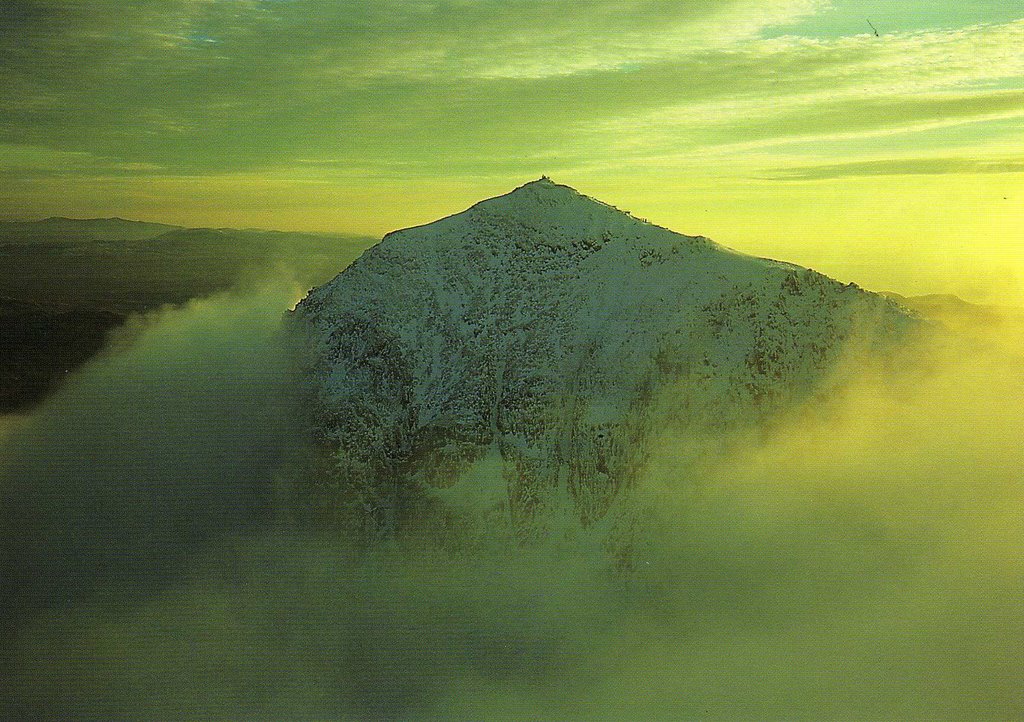
I'm just back from a week in North Wales to see my Mum and sister, and to explore my native country.
I began the journey at my Mum's house, staying with my sister. We visited Mum in the special nursing home the next day, the first time I had seen her there since she got transferred there from hospital last week. I thought I'd be ok with it, thought somehow that her being settled somewhere would make it easier to comprehend her situation, but it didn't. I spent the first afternoon with a dazed head that wouldn't quite attach back to my body, as I walked in and out of her bedroom, nauseous and lost.
The second visit the following day was worse somehow, my Mum has a chest infection again, which is never easy to see her in such physical distress. In the end I had to walk outside in the cold Autumn air with my sister, and rail at the whole situation. It all just felt sick, cruel that Mum is being put through all this struggle in the name of living, when it seems to me that her time has come. I have had it said to me that maybe her time hasn't quite come, maybe she is hanging on for something that we cannot comprehend. Maybe. But without two drips feeding and medicating her, she would not be here right now - it is only thanks to the wonders of modern medicine, and a philosophy that says we must have life, no matter the cost, that she hangs on.
It brings a lot up for me, seeing my Mum like this, in terms of issues such as euthanasia and a human being's free will. It seems we cannot even determine our own death anymore, we can't die with dignity or self-determination, instead we must ebb our days out in state funded nursing homes. I know it is a complex subject, but somewhere it just seems wrong, wrong to subject a person to this. I guess it is perhaps only when it happens to someone you love that you realise what an important and painful subject euthanasia is.
I guess death itself is such a complex thing. Determining at what point someone is still deemed alive or capable of life or having any quality of life is a difficult thing to assess. People don't want to be responsible for making that choice of potentially ending lives that could have maybe been lived longer or even saved. But the price is that people are forced to live on, and it seems in this culture, no one realises that that is often worse thing than dying, for the person, for their family.
As I was sitting outside the nursing home with my sister, I became aware just how kind and strong my sister was. She understood all my anger, my fear, my fear, my panic, my loss. But every day that I was unable to come and see Mum because I live so far away in Brighton, she was there, day after day, going to see her, wiping her mouth and brushing her hair, holding her hand and playing her the radio. In the face of all this seemingly impossible and boundless suffering, she told me in her own way, that there were still little acts of love she could give to our Mum, there was still dignity and humanity she could bring to the situation, and that is what she would do, to the end.
After talking with my sister outside on the front bench, I felt renewed courage, and wasn't afraid or angry anymore. No time for that, these moments are too precious. I returned to my mother's room, somewhere more at peace. It is no surprise that we resist the truth, the awful truth of sickness and dying, because it just hurts so much. The pain of having to let go, in a situation over which, ultimately, I have no control, is hard. But when I can stop resisting, stop struggling, somewhere there are moments of peace, things are just as they are, and I am back again, loving, no longer afraid.
Wednesday night, Bob arrives, on a late train, that was late. We all go to meet him at the station. Thursday is the day he and I take the train to Snowdonia to climb the biggest mountain in Wales.
Friday, October 06, 2006
Thursday

12.30pm, at Shotton Station waiting for the train to Llandudno. We have just arrived from the tiny train station at my village, Hawarden.
My mother was raised in Shotton, my grandparents lived here all their lives, as well as my Great uncles and aunties and other relatives. This tiny steelworks town, grey and rainy, is infused with memories.
I used to love coming here as a child. Only a few miles from my Hawarden home, I would come to stay with Grandma at weekends. We would walk up the high street, she and I, and I would stare at my reflection in the shiny Tesco's wall, when I was younger, holding her hand, and when I was older, trailing behind her playing with my hair, pretending I was cool. We would go to the pick n' mix section at Woolworths and I would always get strawberry creams and a small packet of After Eights for 20p. Sometimes she would pop a toffee from the pick n mix into her mouth, giving me a naughty knowing smile as we walked up and down the aisle.
If she didn't have a pan of scouse waiting for us in the pressure cooker when we got in, or braising steak with thick gravy, we would get fish and chips from the chippy at the end of Shotton high street, with Angel Delight for pudding if I was lucky. Apart from my Grandma's jam turnovers, Angel Delight had to be my favourite ever pudding, especially when it was served in her cut glass bowls and kept in the fridge overnight. I could clean my bowl in seconds, and would lick the last streaks of pink mousse off the spoon like it was precious gold dust.
When Fridays at school were still half days, my Mum would drive me and a friend to Shotton, to the 'icey'. There I would watch packets of crisps drop from metal pincers in the crisp machine, slurp my Slush Puppie that turned my lips blue, eat Monster Munch and whirl around the ice rink to the sound of echoing music. I cherished those Friday afternoons, the smell of ice and children and the way it felt when I had finally laced my ice skates up, and was padding across the black rubber flooring to the entrance of the freezing rink.
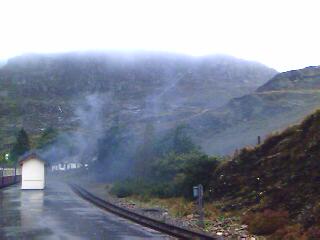
It's raining. It's been raining on and off for days now. It has gone straight from Summer to the heart of a British Winter in four days, it feels. We are on the train to Blaenau Ffestiniog now, from there, we will catch the steam train and chug our way deeper into the heart of North Wales. A young girl on the train is teasing her mother in Welsh. I don't know what she is saying.
Everything is so cheap here in Wales, so unpretentious. It makes me realise what a blag so much of Brighton is. Yesterday, in Mold, I bought a pair of boots for £3.50, and shoes for a pound! Bone china cups for two pounds each.
My sister and I ate lunch in the kind of café I used to come to a lot when I was a teenager, with my first boyfriend. The entire place was heaving with fat old ladies with chronic health problems sitting on orange plastic chairs, smoking fags at the tables. We got a proper cup of tea, and a 'milky coffee', (instant coffee and hot milk kept warm in a huge pot on top of a stove.) It tasted fantastic. The owners were collecting money for one of their washer uppers, who has recently found out they have cancer. A fat lady in a wheelchair commiserated:
"I was in hospital recently, and they cut the wrong vein. Terrible it was. They don't care, you know, you're just a number to them. But then, as I was lying there, I had to think, when I was younger I was a matron in hospital, and I'd go and see all those men who had lost their arms and legs who were in the Paraplegic Ward, all there, back from the army, and I'd think 'there's always someone worse off than you.' Yes, there's always someone worse off than you. Anyway, I'd better be going, I'm on a hunt for Shredded Wheat, reduced sugar.."
With that, her son span her out of the café in her wheelchair, a somnambulistic look across his face. Somehow I feel like there is a woman like this in every cafe or bar across the Western world, telling such a tale, with a cigarette in her hand, and glasses, dyed hair and a son with an impenetrable sadness in his soul.
Wales, I always feel so much more at home here, and always such an alien.
The land is rising up. From the coast train past Rhyl and Prestatyn and Colwyn Bay, now we are deep into country where the hills are starting to rise, fir trees pointing upwards from their peaks. The grass is verdant, almost luminous in the rain. Slate walls, slate paving, slate rooves under the cloudy slate coloured sky. The Welsh landscape. Moving, primal. It's time to get my raincoat out.
Thursday, October 05, 2006

So we did a trial run of the mountain in the rain on Friday, with the intention of just ambling up the Watkin Path to take in waterfalls and woodland and general picturesque beauty. In fact we ended up climbing two thirds of the way up Snowdon, so hard it was to turn back from the ominous magic of those blackening peaks that we gradually edged up towards.
Saturday, we were out of the house by half past eight, on the bus for nine, and at the foot of Snowdon before ten. A quick coffee and a fried egg butty for me and we were on our way.
My legs aren't used to this. This becomes clear after about five minutes. This is going to be no easy climb. But the mountainside increasingly drops away beneath us, and we climb, slowly, steadily, towards the distant cloudy peak. Fellow climbers surround us at every pass, for it is Saturday, and a clear fresh morning.
We climb for a couple of hours, aiming for the point where the path splits into the one to Snowdon and the one up to Crib Gogh, with its dangerously narrow snaking ridge. As we turn the corner of the path, the mountainside gives way to reveal huge green lakes, sunlight streaming over the waters. And we are standing on a giant halo, a crystal strewn mammoth of a rock. In front and behind us our fellow climbers, in all shape and forms, the same as me, pant their way forward, increasingly red faced, exhausted.
As we get higher and higher, I realise why I am doing this. From gentle, inspiring rolling green beauty, the mountain changes to a denser, darker presence which strikes me speechless and unnerved. Immense and watchful, Snowdon is power, and we are merely crawling across its vast body like tiny insect babies. At the same time, its power fills me up, imbibes me with a determination and desire to reach its top.
The further and further up that we go I realise, tears down my face, that this place can hold all the strongest stuff of life, love, loss and suffering, it feels like it can hold the whole of existence itself. And as I walk and I watch the grey and black and brown of Snowdon approaching, I can feel my mother, she is here too, she is in the mountain, she is the mountain, and this climb I am doing is life itself, is death, is ending and beginning, endurance, hope, struggle, surrender. With every step my body comes alive, despite the strain and soreness, despite the strong desire to rest. My legs haven't felt this way since I was a child, probably since I used to go walking in Wepre Woods with Mum. For miles on end we would go, through trees and over brooks, up steep banks and over styals, through mud and ponds and endless fields. And here I am, halfway up a mountain, and I am eleven years old again.
After three and a half, maybe four hours, we finally reach the top ridge and make the final walk to the summit. We are above the clouds now, and it quickly becomes freezing. We pile on extra layers hurriedly, wish we had a flask of tea or something stronger. Below us, an endless stream of climbers makes their own journey up to this place, but I can no longer see them. I can see nothing from the top, only cloud, but it doesn't matter, I'm here, I made it, and somehow, everything makes sense.
Wednesday, October 04, 2006
Darkness When The First Light Was Born
Homage to the world. Homage to the raging fires that eat it alive. Homage to tomorrow. Homage to the day when none of us will wake up. Homage to ships and planes. Homage to speeding clouds. Homage to the stripe on the zebra's back. Homage to all fallen prey. Homage to the predatory. Homage to light. Homage to the baby's skull. Homage to machinery. Homage to apparatus. Homage to buildings and to streetlights. Homage to my sisters. Homage to bad friends. Homage to mistakes. Homage to silent birds. Homage to snow.
Homage to stereos. Homage to the yellow stain on my mother's nightdress. Homage to kissing. Homage to fingers. Homage to harrowed eyes. Homage to brilliance. Homage to stupidity. Homage to sex. Homage to abstinence. Homage to a blue sky. Homage to apples, unripened fruit. Homage to leprosy of the soul. Homage to worshippers. Homage to the uncontrollably vain. Homage to TV. Homage to the hermitage on a hill. Homage to the ringtones of teenage children. Homage to their fathers.
Homage to the dying. Homage to every tear wept at their bedside. Homage to my mother. Homage to my father and his ebbing mind. Homage to animals and to beasties. Homage to the night. Homage to the frail, the ugly. Homage to superstars. Homage to the brave. Homage to power stations. Homage to sadists. Homage to euthanasia. Homage to the suicidal. Homage to insects. Homage to bats, eaten alive by beetles. Homage to caverns. Homage to church steeples.
Homage to the beatific. Homage to the horrific. Homage to the damaged and needy. Homage to air. Homage to sunlight. Homage to wrinkles. Homage to breath. Homage to limbs. Homage to eyesight. Homage to decay. Homage to the Atlantic Ocean. Homage to gravestones. Homage to small Northern towns. Homage to nonsense. Homage to the written word. Homage to mystics. Homage to tenderness. Homage to the cry of the wind. Homage to bad smells. Homage to the face in the mirror. Homage to you. Homage to me. Homage to waving goodbye. Homage to the end.
Sunday, October 01, 2006
Thursday, September 28, 2006
Hope To God I'm No Greeting Card
I've not done any substantial writing for a long time now, it feels. I've spent most of today and yesterday either at, or at least hovering around my piano keyboard in some tense, exploding state of consciousness. Creating makes me feel like the bird that has just broken out of an egg. Exhilarated, breathing, insane.
I pace the flat for something to distract me from the inevitable truth of those black and white keys. And still I haven't written anything of note for a long time now. The novel, or at least the drive towards a novel, on the 'back burner', that is, crept back into the recesses of my mind. A book of short stories, is reduced to two ideas only: birds' nests and windy places.
The post sinks into the ground. I am more preoccupied with things that make no sense than those that do. I walk to the shop. I walk back.
This thing I call creativity makes me happier than any sex, is as great as the greatest love. And sadder than all sorrows put together. I like myself a lot when I write, because I am not hindered by my own 'thereness', I am free to wander into whichever room of experience I please, untroubled by my own preferences and predelictions. And I sometimes hate all that I am too, saddled by my insecurities and cracking bravados, on nights like these.
Tonight, experience is painful and the rain dances.
But creating is giving birth, it is about something being birthed, born. And as I feel like the chick out of the egg, I also feel like the bloody mother, I can feel my body torn in labour. So this is a necessary pain, a necessary tension. Like new teeth pushing through gums. Skin ripping open.
And for what? For what reason do we give birth in this way? For sure, there is no fulfllment for me without it, to let the words or the song come into fruition without the tension of struggle, without working for it. Those slippy slidy works of supposed art, that trip so easily and so correctly off the smoothest tongue, they leave me unmoved by their composure, by their lack of a crime scene. No dying bull to trace in the sand, no ideal to stretch to the limit. Art can never be hidden behind, but exposes it all, all the workings. Ah, we are all so clever at this, still we try and tame the animal, lassoo it all so it belongs to us, not the other way round. Idiots, we are.
Can we make poetry with the head? Some people seem to think so. We can stare out to space with special instruments, we can calculate the mass of the world. We can float in space suits far above this bluest planet and watch the gases and the atmosphere, imbibe the greens and the corals and the turquoise patches, sail the infinite seas above, notating the wonders with a biro pen. And what does that make us? If we don't see it, it is all just another TV show, just an interesting experiment.
Poetry is not an interesting experiment. It is living, life itself. It is the often agonising process of opening up to what this universe is made of, and looking around, taking it in.
It is a space ship that travels to places otherwise unreachable, no other vehicle has the engine power, the correct design. It brings this human back, with the wonders and horrors of the world, of space, to write shakily some 'feeble approximation of starlight'.
It also travels underwater, to where the plants and the jellied fish grow. To where light cuts out under the ice, where sound is an ancient song from far above tides.
Descends, descends, past trees and caves and earth and matter and stone, into the stone it goes, the greyest, smoothest stone. Then the peat, and the ashes, the burnt out coal, the embers, the black chalk in the fire, soil and worms. Feel it in your hand, cool dark and sodden.
To the people, the stares, the unrelenting dreams. We say we are a million miles from the sky and the wood and the ground, from under the water.
No, we are the same life. In the human, there is always the valley and the rock, the repetitive seasons and the swimming fish. Discovered lakes, so much unchartered territory. The horrors of the flesh, the sinking stone, buried under ivy, human sleeps with fur and paw, eats its brother, dazzles with the sunlight and becomes dawn itself.
We are the night and the day, the afternoon, Northern Lights. We are neutron stars, gas and pollution. Moving in a haze of cloud. Whiskers. Dead creatures. Our own faeces. The blazing cottage. The never born girl child, left in a dream. A window, this book you hold, spent, spent, always spent.
This is all poetry to me. And to sit with that, is to sit with life itself. And the bravest poets are the Captains of the Boats at roughest sea. They bring the words home, they inspire, touch the fabric, rub the thread between their old warm fingers.
If I ever doubt poetry has a purpose, I think of this. I think of the bold. The death defyers. On a night like tonight, that I can be so bold, take these controls and launch again, is all I ask.
Wednesday, September 27, 2006
Sunday Best

Well, the afternoon Tea Party went down a storm on Sunday, with cakes, Assam and ginger cake galore. It was a magnificent afternoon, the weather holding out, and the sun daring to shine. We all wore our Sunday best and I even put on a bit of Edith Piaf and Django Reinhardt to add to the atmosphere. An eccentric affair, the kind that always bring the biggest smile to my lips. More afternoons should be spent like this - there is something poignantly beautiful about such a spread on the beach, with all your friends, watching as the sun sinks behind the horizon and Summer ebbs its way from the tides of the shore.
I finally have some more time off, so today I am working on a song at my keyboard. Oh, the joy of solitude.

Saturday, September 23, 2006
Subscribe to:
Posts (Atom)