I've been grateful, of late, to notice small slivers of daylight still hanging in the air as I walk up Church Road, even though the clock has already struck five thirty. These tiny shards of optimism, breaking through the winter chill, warm me, and offset the heavy feeling I've had of late, the feeling of dark birds clustering at every street corner, following me home.
I can't quite separate out these last months into any tangible order; they've been a peculiar mixture of sadness, hope and bewilderment. These last few weeks have been no different, and I'm driven by the feeling that some things in my life are finally coming together, whilst the rest of it unravels.
After a drought of money and work for the last year or so, a couple of weeks ago, I suddenly found myself standing in an avalanche of decorating work and some writing work too. I could finally allow my dreams of a trip to Andalucia to surface again, as well as my vision of spending money on a new pair of jeans, a pair that I actually like (and isn't from some knock-down store or passed onto me by a charitable sister: wrong size, full of holes).
But I've not quite been right since that last trip home to Wales in January. The strain and enormity of my experience there cast a strange shadow over everything when I returned to Brighton, leaving me disorientated on buses, forgetting where I was headed to, my head spinning in all directions as I walked past cafes or spoke on the phone. A flooding in my heart, a weirdness afterwards, a feeling that my consciousness was leaving me in some way.
I realised the other day that this wasn't simply a case of me being a bit overwhelmed, but actually something very physical was up. For the last four months this strange feeling in my chest and my mind, a swamping of my senses and a disturbing feeling in my body has been coming and going, depending on the time of the month and how tired I am. Due to everything else that's been going on, I'd just seen it as another wave in the sea of unsettling experience, and got on with it. But over the last few days it's worsened, and I've had to face some facts.
So, following a conversation with my sister, who is utterly convinced that I'm epileptic, since my symptoms match hers exactly (she is epileptic) I've been back to the doctor for referrals to a neurologist and cardiologist. I wouldn't surprise me if it was epilepsy either, but it also wouldn't be a shock if it was just another form of panic attacks, frequent and savage.
The bottom line is, I have to take it easy, easy within a sudden life change of being incredibly busy. How ironic. At a time when I need to avoid computer screens and caffeine, I find myself having to spend days writing book reviews. When I need to rest and avoid stress, I'm wobbling up a ladder working to deadline, with strong paint fumes swilling in my brain. But I'm determined to go softly. Whatever it is that's going on with me, that much I know.
So I'm off to curl up in bed with a book, feel the night dragging in the sky outside my bedroom window. I'm not bothered if there aren't any stars out tonight. I just want a clear, fresh morning tomorrow, light and breezy, filling up my step and my lungs with graceful ease.
Showing posts with label doctors. Show all posts
Showing posts with label doctors. Show all posts
Thursday, February 07, 2008


Monday, March 19, 2007
Wednesday
I went to see Mum at the nursing home the following day. She looked crumpled, lying in exactly the same position she was in some months ago when I last saw her, as though time had stood still. The only difference was the paleness of her skin, and her eyes. It broke something in me, to see her like that. When she looked at me, she seemed to be saying 'get me out'.
My sister had made a compilation cd of all my Mum's favourite songs and show tunes. I put on It's Not Unusual. Mum used to love dancing around to this, shaking her arms from side to side, swaying her hips. She fancied Tom Jones like mad. Then I put on Copacabana and sat by Mum's side singing along, my sister in the background doing a little dance. There was no response. In the end we turned it off. I remember watching Barry Manilow concerts on the telly with Mum in the living room when I was growing up. We'd sing along, especially to the slow ones, where the middle-aged women in the audience would sway in unison to the music, holding their lighters in the air high above their heads.
Emma went off to give me some time with Mum alone. I put on Relaxing Piano Classics. I really don't know what Mum makes of all this. I sat next to her by the window whilst Clair De Lune played. Mum stared out at the same spot she always stares at. A robin hopped onto the bird table outside, and started pecking at seed. I pointed at it, encouraging Mum to look. There was a flicker of interest in her eyes.
I watched her, watching the robin. Then I turned back to look at the robin, so tender and slight, flitting about the table. The piano ebbed and flowed like white foam on water. I felt myself breaking into tiny pieces, dissolving into the sound of the piano keys, the sight of the pecking robin and the blue of my mother's eyes.
~~~~
We went to see the doctor early next morning. I trembled as I went inside her room, as she asked my sister and I to have a seat.
Here was a kind doctor, whose words were a balm on all the cuts that have been building up on me since my mother's first stroke, over six years ago; on all the cuts that the tens of doctors who haven't understood, who haven't bothered, who have deprived us of answers, who haven't had the time to care, have left. For the first time I felt I was being listened to.
I tell, for the first time, how I feel about my Mum being kept in this awful state, where she is neither here, nor gone, powerless and voiceless, forced to reside in some half-way world, unable to let go, unable to return. I have become sure that she doesn't want this, that she isn't a willing participant in what the doctors have decided is the easiest course of action. It is one that we never had any say in, and Mum certainly didn't.
I expect the doctor to fob me off with platitudes and protocol. Instead, she turns and says to us "It's no way to live".
When I see my Mum later, I feel differently from the day before. I feel like I can finally look her in the eye and say "Mum, it's going to be alright".
My sister had made a compilation cd of all my Mum's favourite songs and show tunes. I put on It's Not Unusual. Mum used to love dancing around to this, shaking her arms from side to side, swaying her hips. She fancied Tom Jones like mad. Then I put on Copacabana and sat by Mum's side singing along, my sister in the background doing a little dance. There was no response. In the end we turned it off. I remember watching Barry Manilow concerts on the telly with Mum in the living room when I was growing up. We'd sing along, especially to the slow ones, where the middle-aged women in the audience would sway in unison to the music, holding their lighters in the air high above their heads.
Emma went off to give me some time with Mum alone. I put on Relaxing Piano Classics. I really don't know what Mum makes of all this. I sat next to her by the window whilst Clair De Lune played. Mum stared out at the same spot she always stares at. A robin hopped onto the bird table outside, and started pecking at seed. I pointed at it, encouraging Mum to look. There was a flicker of interest in her eyes.
I watched her, watching the robin. Then I turned back to look at the robin, so tender and slight, flitting about the table. The piano ebbed and flowed like white foam on water. I felt myself breaking into tiny pieces, dissolving into the sound of the piano keys, the sight of the pecking robin and the blue of my mother's eyes.
~~~~
We went to see the doctor early next morning. I trembled as I went inside her room, as she asked my sister and I to have a seat.
Here was a kind doctor, whose words were a balm on all the cuts that have been building up on me since my mother's first stroke, over six years ago; on all the cuts that the tens of doctors who haven't understood, who haven't bothered, who have deprived us of answers, who haven't had the time to care, have left. For the first time I felt I was being listened to.
I tell, for the first time, how I feel about my Mum being kept in this awful state, where she is neither here, nor gone, powerless and voiceless, forced to reside in some half-way world, unable to let go, unable to return. I have become sure that she doesn't want this, that she isn't a willing participant in what the doctors have decided is the easiest course of action. It is one that we never had any say in, and Mum certainly didn't.
I expect the doctor to fob me off with platitudes and protocol. Instead, she turns and says to us "It's no way to live".
When I see my Mum later, I feel differently from the day before. I feel like I can finally look her in the eye and say "Mum, it's going to be alright".
Wednesday, October 11, 2006
Eileen Scott
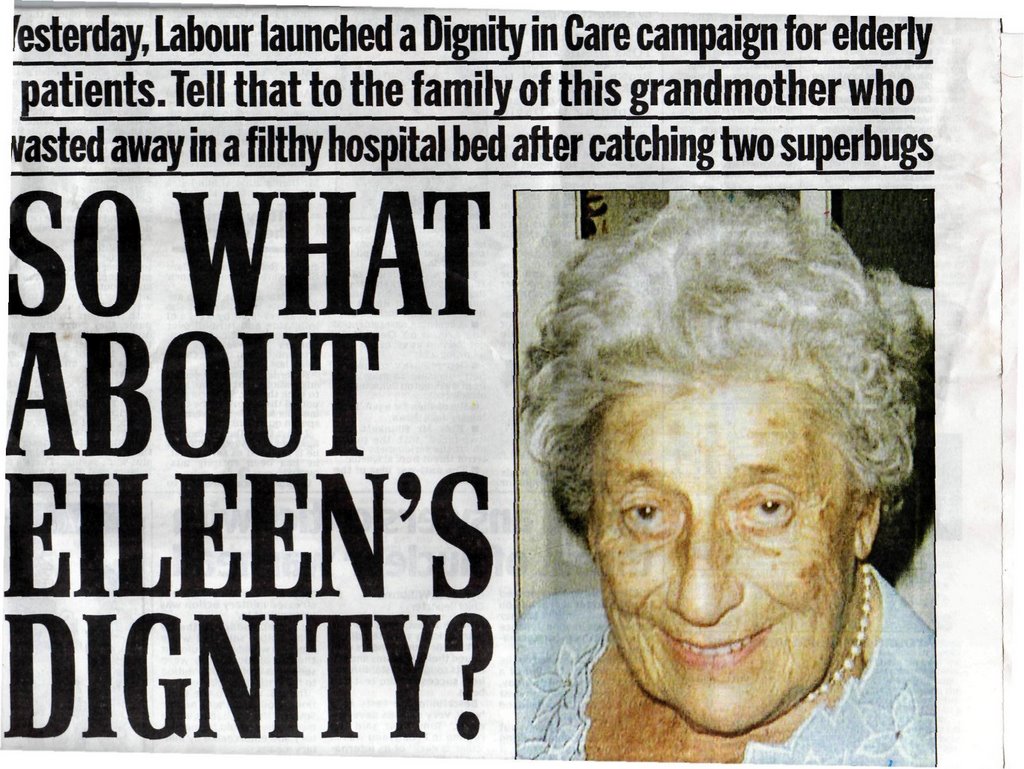
The other week, I got into a fairly intense discussion with my hairdresser about euthanasia and the NHS ( he's quite an intense hairdresser). He's French, and he told me how, when his grandfather was seriously ill recently, he went to visit him in a French hospital, where the standards made British hospitals look frighteningly archaic. The standard of hygiene over there is exceptionally high, as is the nursing care. Apparently there is no such thing as M.R.S.A over there, the hospital superbug that is ravaging our British hospitals.
This story that I read in The Mail, though of course designed to throw a hefty punch at the Labour government, is not unusual. It seems like it could be a somewhat sensational horror story, perhaps a terrible one-off, a tragic mistake.
However, when my mother was in Chester Countess Hospital, at least five women in her ward of eight had contracted M.R.S.A, at least one of whom I know to have died. And they left my Mum in that same infected ward for two days, saying there was nowhere else to put her, and then, in the end, telling us that in fact it was, perversely, the safest place for her to be, because everywhere else they could have moved her to was in fact even more risky, with an even higher count of the superbug.
This story of Eileen Scott does not shock me, the elderly woman in question contracting and finally killed by two strains of a superbug from a non-life threatening complaint for which she was admitted into hospital. Further, she was left in her own excrement for days, regularly not fed because the nurses were too busy, and was only admitted to hospital the second time because of a shoulder fracture which she suffered when two nurses tried to move her.
I remember the shocking treatment my Mum got in the Chester Countess Hospital, how run off their feet the nurses were, how little thought and care was put into my mother's healthcare and comfort. It was diabolical. If we hadn't been going in every day, and then my sister continuing to go in every day after my other sister and I had left, to attend to Mum' basic needs, I shudder to think of the state she would have been left in. It was one of the worst aspects of Mum being so poorly, knowing how badly she was being looked after, how dangerous thew hospital was in terms of M.R.S.A., other superbugs and general misconduct (Mum's pneumonia was probably caused through a nurse accidently knocking out her drip).
And yet, both patients and their families at such a time are rarely in the position or state to be strongly challenging the hospital management, and even if they did, wouldn't be likely to get far through the red tape.
So the Government are launching a campaign of 'Dignity In care' for elderly patients in hospitals and in care homes. If the Government want to implement 'dignity in care', I think perhaps not forcing sick elderly patients to sell their own homes in order to fund time in care homes might be a start.
My mother was lucky, she was deemed part of a process of 'continuing care' from the hospital, and her Nursing Home was funded. But it was only by the skin of our teeth that we got that, and I know how horrendous it would have been to see my mother's home, our home, forced to be sold, and my sister made homeless because of it, all to keep my Mum in a state which the Government and law deems 'living'. Thousands of other elderly patients are forced every day into such a situation.
There is very little respect or understanding of the elderly in our culture today, as I think there is little understanding of the deeper issues around what it means and what it takes to give dignity and choice to the 'living'. Perhaps as well as throwing a bit of money at the NHS and care home funding, the Government would do well to invest in more deep medical, and yes, I'd say spiritual or psychological investigation into what it means to be alive as opposed to just medically 'living', how it feels to be suffering from disease or illness, or to be facing death, how it feels actually being elderly. From what I have seen, the elderly, especially the sick or disabled, are largely patronised or forgotten, pushed away out of sight, often their choices and dignity taken away from them.
Ours is a superficial understanding of what it means to age, and what it means to get sick, what it means to live and what it means to die. As usual it is not just money that continuing health care for old people needs, but education, awareness, and yes, humanity. We will all be there one day, if we make it. Let's hope this new campaign shows some of that, but I won't hold my breath.
Subscribe to:
Posts (Atom)