Showing posts with label body. Show all posts

Saturday, June 12, 2010

Navel Gazing

The younger I was, the more I investigated my body’s secrets. I explored each tiny place with curiosity: palms against soft, white skin, fingers poked in ears, bitten nails skating the dip of my throat. My body was not just familiar territory – it was my very own erratic, unkempt kingdom. Until puberty, I didn’t judge the merits or defects of the blood and bones that kept me alive, I only marvelled at its wonders. I’d sit on the stool in front of morning re-runs of Batman, peering down into the dark cavern of my nightie, breathing in its musty smells, touching the mole on my upper thigh, pulling at a new scab on my knee.
     
However, when I reached eleven or twelve, things changed. I swung from fascination to repulsion with my body, depending on my mood or what magazines I’d been reading. We were close like lovers - sometimes at peace, but often warring, confused, simmering, full of desires and woes. Still we remained allies against the outside world.
     
But as I grew older, we gradually parted company. And as others began to explore my body, I knew it less. Each nook, each tangle seemed less remarkable to me as others uncovered it. As lovers commented on its curiosities and miracles, I grew bored, forgetful. When I was nineteen, I got my belly button pierced. Perhaps that was the start of it. As seems the curse of pubescent girls, my teens had been wracked with bodily despair and an obsession with perfection – perfection that, naturally, I’d never achieve. I had longed to get a piercing since I was thirteen - as though somehow that would empower me, taking me out of teenage insecurity into something deeper, darker, more primal. Though it was years later, getting it done somehow felt like a rite of passage. In that Withington bedroom, lying there as my tattooed friend leaned over me in his black, sleeveless T-shirt, I had fainted, my belly button disappearing beneath a sheer bolt of silver. He screwed a tiny silver ball in at one end and I didn’t see my belly button again for another eighteen years.
     
When I was little I used to spend hours playing with my belly button  – an ‘innie’ - small, round and perfect, serving as a secret hiding place for toast crumbs. When the piercing fell out in the bath a couple of months ago, I decided not to feed the silver bolt back through again. Despite the unsightly scar I liked seeing my belly button. It felt ‘natural’, whatever that means, and as though I was recovering some aspect of innocence – all fresh, pink and soft.
     
It’s unnerving to think that the umbilical cord attaching me to my mother was imbedded in this unassuming tissue. And that the cord no longer exists, as she no longer exists. Yet the hole remains, and surprisingly, for the first time in a long time, I can see it. It's a full moon lighting the way back to that place from which I emerged, where I once belonged, wrapped up in wet unconsciousness, blind, unaware of my skin as separate from hers. One red flesh, pulsing together.
     
I stick in my finger, pull the sides apart, and look inside. It’s still small, round and perfect. I wiggle the finger in that black eye, a warm aperture, a relic of an eternally lost hiding place. Can that cord continue, I wonder, or has it irrevocably snapped? Could I become a mother? Inside me, an unknown beating heart, some tiny pupil into which my body pumps all that I gorged on as a child, all that was given me by my own, unseen mother?

Tuesday, October 23, 2007


I've cut my hair again. Happily (and somewhat unusually) for me, I am experiencing absolutely no post-haircut regret. In fact tonight I'm loving it and am, as a result, rather smug.

I'm also thinking again about what is going on underneath all this compulsive haircutting. I seem to be trimming and pruning almost weekly, my hairdo creeping shorter and shorter, its style wavering about, curling and creeping behind my ears, seeking its shape. With each snip of my scissors, I feel like I'm desperately trying to match how I look on the outside with how I feel on the inside.

My appearance has always been massively significant in my world. I have hidden behind femininity and then I have slung it out in fury. I have utilised its powers and I have been crippled by its limitations. I have blundered around confused as to what this thing called womanhood even is. My clothes and hair have always played a vital part in that, from a childhood of boys' clothes and loathsome haircuts to long hair and a precocious, feminine sexuality at thirteen, when I was a loner indie-kid in my uniform of biker boots, black eyeliner and short skirts. By 15, I was a raver, popping pills and returning happily to baggy trainers and jeans and sexless Mambo T-shirts.

I don't think I really felt remotely female until my early twenties. I think I could pretend like I was one, and there was some sort of inkling in that direction, but on the inside, it just didn't match up. I would scour the magazines for pretty girls who felt like a different species from me.

Also, I realise I can also actually recount the entire last ten years purely in terms of what shade of colour I was obsessed with at the time. At 23, I discovered Buddhism, festivals, hippies, meditation, chakras and Reiki. I moved to Brighton where the sun always seemed to be shining and felt like I had escaped from a lifeless, colourless, dowdy, grey cell. During this period I became obsessed with turquoise, silver and baby pink. I painted my entire bedroom bright turquoise and hung glitter balls from every part of the ceiling that reflected the sunlight a thousand times over. I made a large silvery glitterball shrine devoted to Vajrasattva, the Buddha of purification. He was my discoball Buddha. I wore little baby pink jumpers and sparkly blue dresses and I painted my nails silver. Sounds foul, I know, but I still think it was kind of kookily cool. I revelled in cosmic-girly chic, young and vibrant and a world away from how I'd felt for the previous 7 years, which was old; old and grey as the fucking mountains.


Then I started to get a bit of a feeling for some inner sexual power and my real passions and desires. I got into Mary Magdalene and Rilke and Patti Smith and became obsessed with dark purple. My bedroom became a dimly lit shrine with an abundance of Evolution shop netting, Edward Munch pictures and dyed blue roses. My next room was similar, but this time with little sculpture shrines of broken glass around it, a Garcia Lorca poem handwritten around the top of its walls and a huge purple swirling vortex I'd painted on one wall, six feet high. Then I broke up with my boyfriend and painted over the whole goddamn room in coconut and duck egg blue; light, grounded and non-intense colours. I got rid of the broken glass and the Lorca poem with the painful relationship. I was done with intensity.

When I moved into my present flat, the decor and all my clothes went green, right down to my purse. I became a lady, with a wide brimmed hat and a flat full of birdcages and spotty scarves and flowery teacups. I wore polka-dot flamenco skirts and neckties and my boobs even grew, so for the first time in my life I had a cleavage to show off. I liked my new life as a lady. It was kitsch and camp and over-the-top feminine. It suited my newfound curves and womanly figure. I dressed up in frills for festivals with my friend and we sold chocolate energy balls and gave out free spankings to the highest bidder.

I have a certain fondness for retro chic. The Twenties, Thirties, Forties, Fifties, Sixties, Seventies, I love them all (though I'm still not sure about the Eighties). I find it hard being a modern girl. And at present, I am finding it hard being a girl at all. I have largely eschewed the frocks and skirts, the busty tops. My flat is still a haven for birdcages, Venetian masks and flowery teacups, but the flamenco dresses are firmly at the back of the clothes rail. I've taken to wearing more boyish clothes, comfy jeans, shirts, caps, jackets and sometimes, even ties. I feel stronger somehow in these clothes, and less in need of something, even if I'm not sure what that something is. And I have cut my hair off for the first time in my life.

During a lot of this year, I felt like I just wanted to look and feel boyish. I felt constrained by my hips and my curves as much as I felt constrained by my still insistently alive desire for affirmation from men. I wanted to be free from all of it, perhaps a skinny, boob-less boy-girl. Perhaps I wanted to be free from gender altogether, from sexuality, so I didn't have to work out what it all meant and why it was felt complex. On the one hand I began to renew my interest in gender politics and on the other, I was falling for poetic images in Christianity and saints such as St Francis of Assisi.

Although to some people it may seem like a deep contradiction, to me it feels like maybe it was no coincidence that, as I started going to local Queer events where cross-dressing, sexual ambiguity and androgyny are the norm, I also began going to church and following the trail of saints such as St Clare, who defied religious convention by sneaking out of church down a secret passageway to join St Francis and others in a new, radical way of life, as she experienced a holy conversion. In the dark of that night they helped her cut off all her beautiful hair.

There are now days when I wake up and I want to look feminine and definably a woman. It feels good. So when I stood in front of my bathroom mirror tonight inspecting my new self-administered haircut, I suddenly realised why I liked it so much. There was, at last, the start of a synthesis. It was that same synthesis I've been seeking inside myself these last months.

It is a synthesis of different sides of myself, where one does not have to reject the other for its own survival. Where I can feel masculine and feminine, boy and girl, woman and man and all the shades in between; where those words mean everything and mean nothing at the same time. Where my desire is my own, and not something reflected back to me through the half-light of another's desire for me. Where my sexuality is not what my identity hinges on, and men (and women) do not hold the keys to my self-worth. Where I am hard and soft, potent and yielding, receptive and active. It's a place of the hunter and the hunted, the chaser and the chased (chaste), the doer and the doing, the done; the giver, the taker and the giving itself.

When I strip back the layers of conditioning, take off the years of habitual behaviour, the naked sight underneath is a disconcerting one.

The lady and her polka-dot skirts have left the building. There's a strange boy in her place, with very feminine charms and a gentle touch. She is soft as ever, but with a wilful eye. She is the figure in a photo, me at ten years old, pale blue jumper, jeans and Clarks brown shoes.

Last year my mother suffered a massive stroke that left her brain-damaged and unable to speak, eat or move. The strange thing is that I now find that I have almost the same haircut as when I was ten; just as my mother weaves her slow and painful way out of this world. I cut my first fringe earlier this year as she lay looking the other way, out of the window, in a half-trance. Her words, spoken to me regularly from the age of thirteen, have lain dormant in my mind until tonight, yet they were words that always kept me away from the scissors ...Don't ever cut your hair, never cut a fringe, always keep your hair long; such beautiful hair...

Whatever it is I've lost in that beautiful hair as I chop and I snip, is worth it for what I gain, simply from its absence. It's been a lifetime of seeking myself, losing myself, creating identities and shedding skins. The clock ticks, the sea of life surges on, personality unravels to reveal itself in more brilliant colours than ever. The final bed is made; the sheet turned over. The mirror reflects the light shining on it. A bird takes its final breath. I am alone. The bathroom is empty except for one reflection; a face looking back at me. It is nothing I have ever seen before.

Saturday, November 04, 2006

Constanza and The Nun


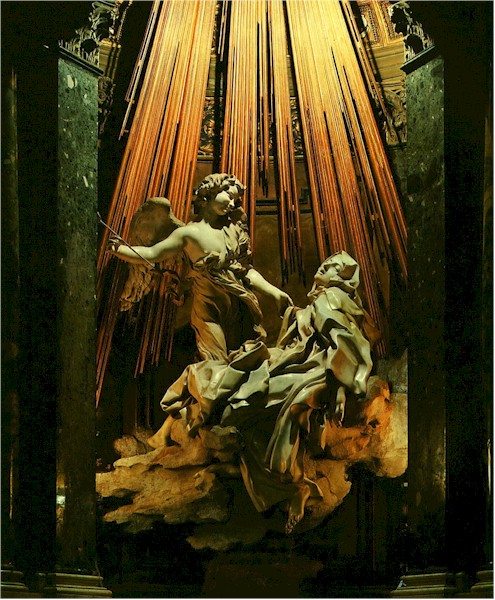
Ever since watching a programme about it last Friday, I can't stop thinking about Gianlorenzo Bernini and his sculpture The Ecstasy Of St Theresa. I feel haunted. In the most transient moments - sipping a cup of tea, throwing a bag over my shoulder to go out the door, turning over in my bed in the early morning, slicing potatoes on my plate, I see the image of St Theresa's enraptured face, turned upwards, her mouth open, the fine point of an arrow entering her, a spray of golden light behind, her robe in swathes around her like liquid sunshine.

It is almost a cliche now to talk of the greatest art as being created by the most messed up people. And true, there is much powerful art that is, and has, been created by men and women where neither mental illness nor egomania is the driving force. But equally as true, genius springs from what is incomplete, flawed, sordid, neurotic, stupid, disparate and ugly. From the gutters of despair, in the midst of crashing disillusion, loss, sorrow, hatred and violence (I wonder if life itself is only as beautiful as its own despair, only as pure as its worst filth, only as strong as the weakest, most despised runt of the litter).

I think of this when I look at the Ecstasy Of St Theresa, and when I remember Bernini's torrid life story, and his dramatic depiction of this woman, a holy woman, and, in particular, of her physicality, her face and body as the meeting place or conduit for divine revelation and bliss.

I think a woman's body, in all its variations, is to me one of the most beautiful forms there is on this planet. It is one which has been, and still is the site of devotion, adoration, violation, reverence, contempt and horror in our world. Exalted, degraded, ridiculed, feared, controlled, desired in a million different ways, a woman's body is as complex as life itself, as death, as dying, as growth and decay, as desire, wanting and repugnance.

Sitting here now, under my clothes, I can feel the skin of this body that I breathe through, I can sense the blood circulating my veins, hear my heart beating in my ear if I press it to my shoulder. My breasts, my hips and vagina, my neck, legs, skin, hair, eyes, buttocks, feet, my back are all realities in and of themselves, but they're also the vehicle for a thousand different projections, some dazzling, some shimmering, some comforting, some lit up in the crudest red light or beset by howling laughter.

Some of these have been handed down to me through time, some are of my era, some through art, through philosophy, religion, culture, literature. Some are inside my own head, most surround me from the outside, from the voices of men, from the voices of women talking to men, from the voices of women who do not care what men have to say. From my mother, from my father.

Am I ever my own woman, I ask myself, can I ever escape this hall of mirrors, know my body beyond its own symbols?

I think of it split and ripped by giving birth, a cell multiplying inside it, growing into foetus, forming, enlarging, holding the blueprint for its own destiny, forming hands and feet, a nose, a throat. A life being born - my body as toil, violent music playing through a crackling stereo. A child moving through me, pushed out by labour and agony through the birth canal, ripped from my flesh, out into cold open air. The uncut umbilical cord, the bloody placenta.

Inside and through this female body, life is formed and grown and expelled with massive effort and incredible physical, mental and emotional intensity. And this intensity, this force and power is there, whether realised or not, in every single woman as part of her physical being.

To me, this force inside a woman is beautiful, and messy. It is complex and it is also the simplest force in the world. A force not different from that of the uncovered grave, a corpse peeping out at us from under the soil. Or from a puja on the Ganges, in a blazing light of candles. Or the baby floating past, its head, a bloated shrine. Its skin, grey.

And yes, it is The Ecstasy Of St Theresa, hovering in the air. But it is also Bernini, the artist who carved it, a year before its conception, sunk to the floor, a nobody, a nothing, the memory of the failure of his greatest architectural ambition ringing in his ears.

As it is the epilieptic nun, scissoring in divine rapture across the wooden floor, eyes rolling in the back of her head. She is not pretty. She is not even beautiful. Only a coarse woollen robe, two pairs of old hands holding her spindled tattered frame in the sunlight that pours through the stained convent windows, too bright to bear without her palm across her face.

And this same force is also Bernini's illicit lover, Constanza, in marble, the loop of her cotton blouse pulled slightly undone, her eyes like wildfire in a forest at night, or a tiger esaped from the zoo, once leashed and captive, now, more than untamed: out of control, hunting, hunting down.

And it is Bernini's servant with a sword, slashing at Constanza's face in retribution until it is ribbons, the pillow soaked in her blood, the colour of her most beautiful dress, of her lust. She will never again have a face that can be immortalised in sculpture. The Muse becomes damaged goods, fallen from ecstatic grace, imprisoned for fornication, disfigured.

So it is Constanza who pays the greatest price for passion, and after nearly killing his own brother and scarring her face for life, the real perpetrator goes free: Bernini, the great hero of Rome becomes an even greater hero, the great hypocrite, scoundrel, egomaniacal amour, liar, destroys and violates in the name of love all that he once created and revered as beautiful, as divine. This woman who was his Muse, who became marble, who fired one of the greatest sculptors in history's world with a blaze of signifiers. Who torched it all with her own betrayal. Whom he will never want again. Whom he will never again watch sleeping through the night, holding his breath lightly so as not to wake her. Whom he will never long to press her small head into his chest as though she were his own restless child.

And now her face is a map of stars, all traced in blood, her honour a withered flower, her wildfire burnt out beyond all reason. Where is left for the woman to go? At Bernini's command she is again caged, this time in a damp prison cell without light, in rags and humiliation, taught the lesson that all women who play with fire must learn in 17th century civilisation, the image of her passion, her beauty, her womanhood, consigned to a sunless locked vault.

This same man conceived and gave birth to the remarkable, transcendent Ecstasy Of St Theresa, long after the light had left his eye, long after such tragedy and violence, after his own sudden descent into failure and his turning to God. And this same woman, Constanza, also gave birth to it, and is enfolded within the creases of St Theresa's robes, in the openness of her mouth, her half closed eyes, though almost certainly neither she or Bernini will have ever known, will ever know this.

Woman, Muse, sister, daughter, mother, virgin, slut, truth, beauty, warfare, corruption, fertility, deceit, the earth, the stars, the moon, the fields, the tether, the breaking of all mundane bonds, the higher, the lower, animal, angel, divinity, a flower, a rose, the scent of death...these words and images haunt me, as the Ecstasy Of St Theresa haunts me, as Constanza and the nun haunt me, as a woman who, like every other woman, is all of these things, who is Constanza and St Theresa, Bernini and the ecstasy itself, and, who, in the middle of the night, or when sipping tea, or throwing a bag over her shoulder to go out of the door, slicing potatoes, is none of them, never has been, and never will.


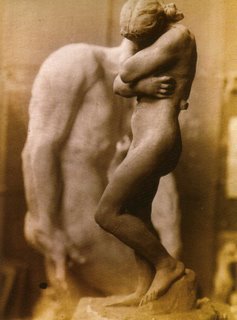
(top image: 'Eve', Rodin's studio, 'Cain' in background.)