I went to see Mum at the nursing home the following day. She looked crumpled, lying in exactly the same position she was in some months ago when I last saw her, as though time had stood still. The only difference was the paleness of her skin, and her eyes. It broke something in me, to see her like that. When she looked at me, she seemed to be saying 'get me out'.
My sister had made a compilation cd of all my Mum's favourite songs and show tunes. I put on It's Not Unusual. Mum used to love dancing around to this, shaking her arms from side to side, swaying her hips. She fancied Tom Jones like mad. Then I put on Copacabana and sat by Mum's side singing along, my sister in the background doing a little dance. There was no response. In the end we turned it off. I remember watching Barry Manilow concerts on the telly with Mum in the living room when I was growing up. We'd sing along, especially to the slow ones, where the middle-aged women in the audience would sway in unison to the music, holding their lighters in the air high above their heads.
Emma went off to give me some time with Mum alone. I put on Relaxing Piano Classics. I really don't know what Mum makes of all this. I sat next to her by the window whilst Clair De Lune played. Mum stared out at the same spot she always stares at. A robin hopped onto the bird table outside, and started pecking at seed. I pointed at it, encouraging Mum to look. There was a flicker of interest in her eyes.
I watched her, watching the robin. Then I turned back to look at the robin, so tender and slight, flitting about the table. The piano ebbed and flowed like white foam on water. I felt myself breaking into tiny pieces, dissolving into the sound of the piano keys, the sight of the pecking robin and the blue of my mother's eyes.
~~~~
We went to see the doctor early next morning. I trembled as I went inside her room, as she asked my sister and I to have a seat.
Here was a kind doctor, whose words were a balm on all the cuts that have been building up on me since my mother's first stroke, over six years ago; on all the cuts that the tens of doctors who haven't understood, who haven't bothered, who have deprived us of answers, who haven't had the time to care, have left. For the first time I felt I was being listened to.
I tell, for the first time, how I feel about my Mum being kept in this awful state, where she is neither here, nor gone, powerless and voiceless, forced to reside in some half-way world, unable to let go, unable to return. I have become sure that she doesn't want this, that she isn't a willing participant in what the doctors have decided is the easiest course of action. It is one that we never had any say in, and Mum certainly didn't.
I expect the doctor to fob me off with platitudes and protocol. Instead, she turns and says to us "It's no way to live".
When I see my Mum later, I feel differently from the day before. I feel like I can finally look her in the eye and say "Mum, it's going to be alright".
Showing posts with label euthanasia. Show all posts
Showing posts with label euthanasia. Show all posts
Monday, March 19, 2007


Wednesday, October 11, 2006
Eileen Scott
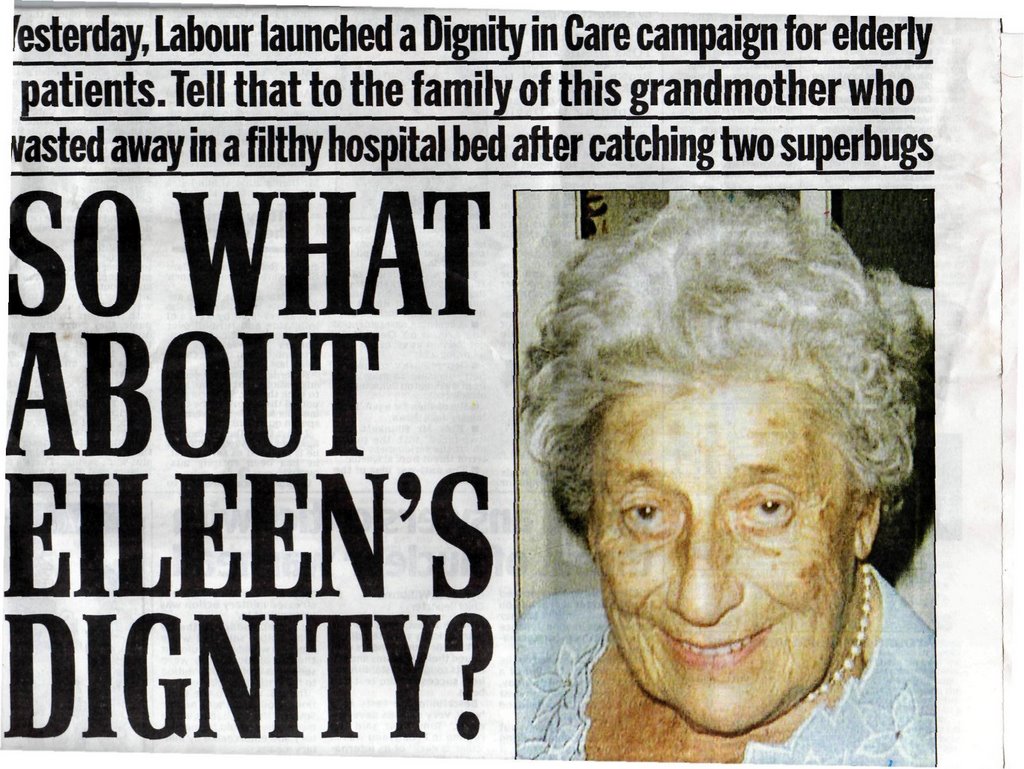
The other week, I got into a fairly intense discussion with my hairdresser about euthanasia and the NHS ( he's quite an intense hairdresser). He's French, and he told me how, when his grandfather was seriously ill recently, he went to visit him in a French hospital, where the standards made British hospitals look frighteningly archaic. The standard of hygiene over there is exceptionally high, as is the nursing care. Apparently there is no such thing as M.R.S.A over there, the hospital superbug that is ravaging our British hospitals.
This story that I read in The Mail, though of course designed to throw a hefty punch at the Labour government, is not unusual. It seems like it could be a somewhat sensational horror story, perhaps a terrible one-off, a tragic mistake.
However, when my mother was in Chester Countess Hospital, at least five women in her ward of eight had contracted M.R.S.A, at least one of whom I know to have died. And they left my Mum in that same infected ward for two days, saying there was nowhere else to put her, and then, in the end, telling us that in fact it was, perversely, the safest place for her to be, because everywhere else they could have moved her to was in fact even more risky, with an even higher count of the superbug.
This story of Eileen Scott does not shock me, the elderly woman in question contracting and finally killed by two strains of a superbug from a non-life threatening complaint for which she was admitted into hospital. Further, she was left in her own excrement for days, regularly not fed because the nurses were too busy, and was only admitted to hospital the second time because of a shoulder fracture which she suffered when two nurses tried to move her.
I remember the shocking treatment my Mum got in the Chester Countess Hospital, how run off their feet the nurses were, how little thought and care was put into my mother's healthcare and comfort. It was diabolical. If we hadn't been going in every day, and then my sister continuing to go in every day after my other sister and I had left, to attend to Mum' basic needs, I shudder to think of the state she would have been left in. It was one of the worst aspects of Mum being so poorly, knowing how badly she was being looked after, how dangerous thew hospital was in terms of M.R.S.A., other superbugs and general misconduct (Mum's pneumonia was probably caused through a nurse accidently knocking out her drip).
And yet, both patients and their families at such a time are rarely in the position or state to be strongly challenging the hospital management, and even if they did, wouldn't be likely to get far through the red tape.
So the Government are launching a campaign of 'Dignity In care' for elderly patients in hospitals and in care homes. If the Government want to implement 'dignity in care', I think perhaps not forcing sick elderly patients to sell their own homes in order to fund time in care homes might be a start.
My mother was lucky, she was deemed part of a process of 'continuing care' from the hospital, and her Nursing Home was funded. But it was only by the skin of our teeth that we got that, and I know how horrendous it would have been to see my mother's home, our home, forced to be sold, and my sister made homeless because of it, all to keep my Mum in a state which the Government and law deems 'living'. Thousands of other elderly patients are forced every day into such a situation.
There is very little respect or understanding of the elderly in our culture today, as I think there is little understanding of the deeper issues around what it means and what it takes to give dignity and choice to the 'living'. Perhaps as well as throwing a bit of money at the NHS and care home funding, the Government would do well to invest in more deep medical, and yes, I'd say spiritual or psychological investigation into what it means to be alive as opposed to just medically 'living', how it feels to be suffering from disease or illness, or to be facing death, how it feels actually being elderly. From what I have seen, the elderly, especially the sick or disabled, are largely patronised or forgotten, pushed away out of sight, often their choices and dignity taken away from them.
Ours is a superficial understanding of what it means to age, and what it means to get sick, what it means to live and what it means to die. As usual it is not just money that continuing health care for old people needs, but education, awareness, and yes, humanity. We will all be there one day, if we make it. Let's hope this new campaign shows some of that, but I won't hold my breath.
Monday, October 09, 2006
Snowdon

I'm just back from a week in North Wales to see my Mum and sister, and to explore my native country.
I began the journey at my Mum's house, staying with my sister. We visited Mum in the special nursing home the next day, the first time I had seen her there since she got transferred there from hospital last week. I thought I'd be ok with it, thought somehow that her being settled somewhere would make it easier to comprehend her situation, but it didn't. I spent the first afternoon with a dazed head that wouldn't quite attach back to my body, as I walked in and out of her bedroom, nauseous and lost.
The second visit the following day was worse somehow, my Mum has a chest infection again, which is never easy to see her in such physical distress. In the end I had to walk outside in the cold Autumn air with my sister, and rail at the whole situation. It all just felt sick, cruel that Mum is being put through all this struggle in the name of living, when it seems to me that her time has come. I have had it said to me that maybe her time hasn't quite come, maybe she is hanging on for something that we cannot comprehend. Maybe. But without two drips feeding and medicating her, she would not be here right now - it is only thanks to the wonders of modern medicine, and a philosophy that says we must have life, no matter the cost, that she hangs on.
It brings a lot up for me, seeing my Mum like this, in terms of issues such as euthanasia and a human being's free will. It seems we cannot even determine our own death anymore, we can't die with dignity or self-determination, instead we must ebb our days out in state funded nursing homes. I know it is a complex subject, but somewhere it just seems wrong, wrong to subject a person to this. I guess it is perhaps only when it happens to someone you love that you realise what an important and painful subject euthanasia is.
I guess death itself is such a complex thing. Determining at what point someone is still deemed alive or capable of life or having any quality of life is a difficult thing to assess. People don't want to be responsible for making that choice of potentially ending lives that could have maybe been lived longer or even saved. But the price is that people are forced to live on, and it seems in this culture, no one realises that that is often worse thing than dying, for the person, for their family.
As I was sitting outside the nursing home with my sister, I became aware just how kind and strong my sister was. She understood all my anger, my fear, my fear, my panic, my loss. But every day that I was unable to come and see Mum because I live so far away in Brighton, she was there, day after day, going to see her, wiping her mouth and brushing her hair, holding her hand and playing her the radio. In the face of all this seemingly impossible and boundless suffering, she told me in her own way, that there were still little acts of love she could give to our Mum, there was still dignity and humanity she could bring to the situation, and that is what she would do, to the end.
After talking with my sister outside on the front bench, I felt renewed courage, and wasn't afraid or angry anymore. No time for that, these moments are too precious. I returned to my mother's room, somewhere more at peace. It is no surprise that we resist the truth, the awful truth of sickness and dying, because it just hurts so much. The pain of having to let go, in a situation over which, ultimately, I have no control, is hard. But when I can stop resisting, stop struggling, somewhere there are moments of peace, things are just as they are, and I am back again, loving, no longer afraid.
Wednesday night, Bob arrives, on a late train, that was late. We all go to meet him at the station. Thursday is the day he and I take the train to Snowdonia to climb the biggest mountain in Wales.
Subscribe to:
Posts (Atom)