Yesterday, I did two decorating estimates. The first was for an older couple. As I entered their rather posh house, both immediately apologised for the amount of sneezing and coughing they were doing, stricken as they were by wretched colds. "Don't come near me!" the man cried, waving his tissue in the air.
During the second estimate, the guy happily announced how he was just over 'it', and how he didn't intend to walk out through his front door again until late spring. Later, I went and paid my rent on Church Road, and the woman in the office (usually somewhat disinterested and abrupt) sniffed feebly as I entered before telling me, her nose almost sunk to the desk, how she hadn't even been able to even smell her Christmas dinner.
So after having spent the whole of my Christmas (except for Boxing Day afternoon: Soho, cream cakes, mad art directors, the hovering spirit of Noel Fielding) and the whole of New Year (both days entirely alone with my Kleenex), ill and partially bed-ridden with a cold virus, I've found that the whole world is steeped in tissues and a vague kind of misery.
This has cheered me up no end. I have a small sense of what it might have been like during the Blitz. A kind of snotty camaraderie is forming between people and I can feel an invisible, mucus-y thread binding me to the rest of humanity. It is the groggy, snotty, raucous cough of interconnection.
Bless. Suddenly I realise that probably most people have had a miserable Christmas, most people have got through it as one gets through a very hard day of explosive- detonation-training at Special Forces Unit Camp, and are now crawling their way forward into the new year with dripping noses and a dangerously low bank balance.
Luckily I don't have to worry about the dangerously low bank balance, seeing as mine is perpetually dangerously low anyway, and my spending on New Year's Eve came to, erm now let me see; NOWT. After bathing in a luxurious concoction of self-pity, bitterness and frustration upon my return to Brighton from Yorkshire (propped up in Bob's car, wondering if it is possible for a nose to actually explode on impact from a particularly violent sneezing fit), I moved into New year with the help of crap music from Kylie Minogue (I know she's meant to be majorly talented, but it's such an effort to stay awake during her 'amazing' performances) and Madness on Jools Holland. You could see how that might be a little soul destroying.
However, I also discovered my watercolour pencils, and, following on from some rubbishy sketches I did at Bob's, I immersed myself in painting some characters I'm thinking of featuring in a little story book that's going round my mind at the moment. So I can say, with some satisfaction, that I passed from 2007 to 2008 in the company of small girl-boys, creepy men in top hats, dogs and some singing nuns.
Art has always been a kind of secondary love for me. I've always been quite good at drawing, and particularly sculpture, but have always felt that even if I applied myself to it, though I might get pretty good, I'd never be as good at it as I would be at writing. I am generally more sound and word orientated. But then, maybe this lack of confidence comes from my art teacher in 5th Form hanging my final Art Project over the Home Economics sink and cackling " Ha! Let's see what she thinks of this!" (She was literally a witch, I think, and we did not get on).
I love art and it feels like a little piece of a puzzle has come back for me through getting back in touch with it. I love creating worlds; usually I do that through words and in musical notes, but when that world grows a face - literally, when you can see the face of that world forming, it is so exciting, it's like growing another sense.
Do you remember that Smiths' line from 'Shoplifters of the World Unite'? I tried living in the real world, instead of a shell, but I was bored before I even began. That's how I generally feel about life. I'd rather stick my head up the backside of genius any day; I'd rather fly around my own head or land on the ear of another listening, twinkling soul who is blinking into the darkness than give this world that rules me the credit and attention it so wrongfully steals.
Yes, in some ways to say this is silly and it's vain. But the world takes from me what it will anyway, and the alternative; this crazy un-sensical magic inside my head, ah, it's a ragingly beautiful fiery mess, and I love it.
Showing posts with label art. Show all posts
Showing posts with label art. Show all posts
Friday, January 04, 2008


Wednesday, October 31, 2007
A Fierce Beauty
Last night I went and spent money that I didn't have on an evening dedicated to the great Spanish poet and dramatist, Garcia Lorca. I commited this rash act (being, as I am, savagely broke), because Lorca happens to be among a handful of artists who have changed my life, and for whom I would, as they say, lay down on the tracks. So parting with my money to go and see it seemed like a relatively small act of devotion.
Unfortunately, the evening was utter rubbish. It took the most razor sharp of passions, some of the most mortally wounding poetry of the 20th century, and put an old, comfy, pair of slippers on it. Though it makes me sad to say it, it was tragically British.

Lorca lived a relatively short life. He was beautiful and he was homosexual, and in the Thirties, Lorca was Spain's greatest living poet, describing and epitomising a spirit of Spain, a spirit that also manifested in flamenco and in the bullfight. In 1936 he was shot dead by the Fascists both for being a poet and for being a homosexual. He died face down in the mud. He wrote these words:
..there are neither maps nor exercises to help us find the duende. We only know that he burns the blood like a poultice of broken glass, that he exhausts, that he rejects all the sweet geometry we have learned, that he smashes styles, that he leans on human pain with no consolation and makes Goya (master of the grays, silvers, and pinks of the best English painting) work with his fists and knees in horrible bitumens..
I think anyone who creates - who writes, plays music, performs, longs for this state that Lorca describes and that runs through all his poetry, because it contains magic and genius. Or perhaps we don't even need to be an 'artist' to have this longing, in life itself we can yearn for it. But most of the time we are so terrified of it that we want to stick to all the safe roads instead; we seek out the poultice of burning glass, but we don't want it to burn our hands.
As I struggle with my own existence, trying to write, trying to make music that might just have some integrity to it; through the loneliness and insecurity of trying to stay with the process and the wildernesses I often finds myself in, it feels a precious thing to try and keep remembering Lorca.
It's horrid seeing the fear of mistakes and failure embodied in another person's performance, as I did last night; to see all the imperfections rubbed out, and with it, all the lifeforce. It reflects what I myself might become if I begin to let those things rule my own poetry and songs, my performance. And it's sad that those musicians' efforts killed even the possibility of anyone in that audience getting the chance to experience the beauty that Lorca lived, and died for. Better perhaps to stay silent, than to kill the thing you love.
Here is some footage of one of the greatest ever Flamenco dancers, Carmen Amaya, who had left Spain by the time of the Civil War and Lorca's death, becoming a world-wide star. Often dancing in men's breeches and a jacket, she danced steps traditionally reserved for male dancers, and she embodies what Lorca describes as that "mysterious power which everyone senses and no philosopher explains.. a power, not a work.. a struggle, not a thought."
He continues "I have heard an old maestro of the guitar say, The duende is not in the throat; the duende climbs up inside you, from the soles of the feet. Meaning this: it is not a question of ability, but of true, living style, of blood, of the most ancient culture, of spontaneous creation."
By the way, the woman in the first video is Eva La Yerbabuena, who is also incredible.
Saturday, November 04, 2006
Constanza and The Nun

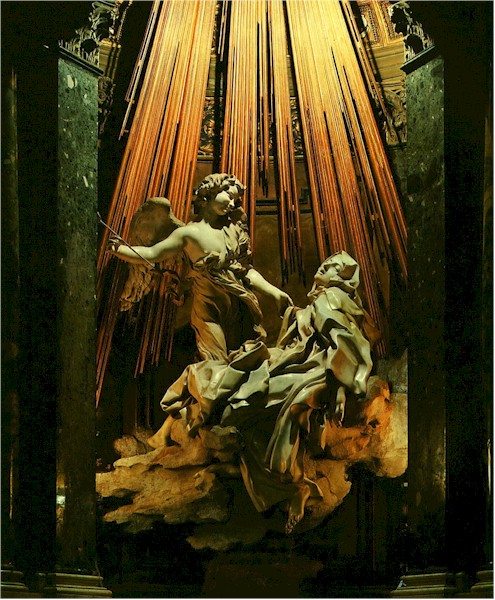
Ever since watching a programme about it last Friday, I can't stop thinking about Gianlorenzo Bernini and his sculpture The Ecstasy Of St Theresa. I feel haunted. In the most transient moments - sipping a cup of tea, throwing a bag over my shoulder to go out the door, turning over in my bed in the early morning, slicing potatoes on my plate, I see the image of St Theresa's enraptured face, turned upwards, her mouth open, the fine point of an arrow entering her, a spray of golden light behind, her robe in swathes around her like liquid sunshine.
It is almost a cliche now to talk of the greatest art as being created by the most messed up people. And true, there is much powerful art that is, and has, been created by men and women where neither mental illness nor egomania is the driving force. But equally as true, genius springs from what is incomplete, flawed, sordid, neurotic, stupid, disparate and ugly. From the gutters of despair, in the midst of crashing disillusion, loss, sorrow, hatred and violence (I wonder if life itself is only as beautiful as its own despair, only as pure as its worst filth, only as strong as the weakest, most despised runt of the litter).
I think of this when I look at the Ecstasy Of St Theresa, and when I remember Bernini's torrid life story, and his dramatic depiction of this woman, a holy woman, and, in particular, of her physicality, her face and body as the meeting place or conduit for divine revelation and bliss.
I think a woman's body, in all its variations, is to me one of the most beautiful forms there is on this planet. It is one which has been, and still is the site of devotion, adoration, violation, reverence, contempt and horror in our world. Exalted, degraded, ridiculed, feared, controlled, desired in a million different ways, a woman's body is as complex as life itself, as death, as dying, as growth and decay, as desire, wanting and repugnance.
Sitting here now, under my clothes, I can feel the skin of this body that I breathe through, I can sense the blood circulating my veins, hear my heart beating in my ear if I press it to my shoulder. My breasts, my hips and vagina, my neck, legs, skin, hair, eyes, buttocks, feet, my back are all realities in and of themselves, but they're also the vehicle for a thousand different projections, some dazzling, some shimmering, some comforting, some lit up in the crudest red light or beset by howling laughter.
Some of these have been handed down to me through time, some are of my era, some through art, through philosophy, religion, culture, literature. Some are inside my own head, most surround me from the outside, from the voices of men, from the voices of women talking to men, from the voices of women who do not care what men have to say. From my mother, from my father.
Am I ever my own woman, I ask myself, can I ever escape this hall of mirrors, know my body beyond its own symbols?
I think of it split and ripped by giving birth, a cell multiplying inside it, growing into foetus, forming, enlarging, holding the blueprint for its own destiny, forming hands and feet, a nose, a throat. A life being born - my body as toil, violent music playing through a crackling stereo. A child moving through me, pushed out by labour and agony through the birth canal, ripped from my flesh, out into cold open air. The uncut umbilical cord, the bloody placenta.
Inside and through this female body, life is formed and grown and expelled with massive effort and incredible physical, mental and emotional intensity. And this intensity, this force and power is there, whether realised or not, in every single woman as part of her physical being.
To me, this force inside a woman is beautiful, and messy. It is complex and it is also the simplest force in the world. A force not different from that of the uncovered grave, a corpse peeping out at us from under the soil. Or from a puja on the Ganges, in a blazing light of candles. Or the baby floating past, its head, a bloated shrine. Its skin, grey.
And yes, it is The Ecstasy Of St Theresa, hovering in the air. But it is also Bernini, the artist who carved it, a year before its conception, sunk to the floor, a nobody, a nothing, the memory of the failure of his greatest architectural ambition ringing in his ears.
As it is the epilieptic nun, scissoring in divine rapture across the wooden floor, eyes rolling in the back of her head. She is not pretty. She is not even beautiful. Only a coarse woollen robe, two pairs of old hands holding her spindled tattered frame in the sunlight that pours through the stained convent windows, too bright to bear without her palm across her face.
And this same force is also Bernini's illicit lover, Constanza, in marble, the loop of her cotton blouse pulled slightly undone, her eyes like wildfire in a forest at night, or a tiger esaped from the zoo, once leashed and captive, now, more than untamed: out of control, hunting, hunting down.
And it is Bernini's servant with a sword, slashing at Constanza's face in retribution until it is ribbons, the pillow soaked in her blood, the colour of her most beautiful dress, of her lust. She will never again have a face that can be immortalised in sculpture. The Muse becomes damaged goods, fallen from ecstatic grace, imprisoned for fornication, disfigured.
So it is Constanza who pays the greatest price for passion, and after nearly killing his own brother and scarring her face for life, the real perpetrator goes free: Bernini, the great hero of Rome becomes an even greater hero, the great hypocrite, scoundrel, egomaniacal amour, liar, destroys and violates in the name of love all that he once created and revered as beautiful, as divine. This woman who was his Muse, who became marble, who fired one of the greatest sculptors in history's world with a blaze of signifiers. Who torched it all with her own betrayal. Whom he will never want again. Whom he will never again watch sleeping through the night, holding his breath lightly so as not to wake her. Whom he will never long to press her small head into his chest as though she were his own restless child.
And now her face is a map of stars, all traced in blood, her honour a withered flower, her wildfire burnt out beyond all reason. Where is left for the woman to go? At Bernini's command she is again caged, this time in a damp prison cell without light, in rags and humiliation, taught the lesson that all women who play with fire must learn in 17th century civilisation, the image of her passion, her beauty, her womanhood, consigned to a sunless locked vault.
This same man conceived and gave birth to the remarkable, transcendent Ecstasy Of St Theresa, long after the light had left his eye, long after such tragedy and violence, after his own sudden descent into failure and his turning to God. And this same woman, Constanza, also gave birth to it, and is enfolded within the creases of St Theresa's robes, in the openness of her mouth, her half closed eyes, though almost certainly neither she or Bernini will have ever known, will ever know this.
Woman, Muse, sister, daughter, mother, virgin, slut, truth, beauty, warfare, corruption, fertility, deceit, the earth, the stars, the moon, the fields, the tether, the breaking of all mundane bonds, the higher, the lower, animal, angel, divinity, a flower, a rose, the scent of death...these words and images haunt me, as the Ecstasy Of St Theresa haunts me, as Constanza and the nun haunt me, as a woman who, like every other woman, is all of these things, who is Constanza and St Theresa, Bernini and the ecstasy itself, and, who, in the middle of the night, or when sipping tea, or throwing a bag over her shoulder to go out of the door, slicing potatoes, is none of them, never has been, and never will.
(top image: 'Eve', Rodin's studio, 'Cain' in background.)
Subscribe to:
Posts (Atom)