Showing posts with label religion. Show all posts

Friday, May 21, 2010

Anyone for Pingpong?

To those who know me well, it won’t exactly be news to read this. They’ve heard it all before. They even love me for it. However, for those who don’t, here it is.
      
I, Clare, don’t fit in. Anywhere. Never have done; never will. The only place where I feel remotely at home is with other people equally as estranged as myself. Even then as some kind of group gradually forms, I never fully feel part of it.
     
Welcome to the human race, I hear you cry.

I’ve tried on various identities throughout my life (as though they were ill-fitting raincoats or top hats). And I spent the first twenty years of my life feeling lost as to what my identity might even be. It was only when I became Buddhist that I began ‘exploring’ different sides of myself. I ditched my long black skirts for sky-blue dresses stitched with swirls (gazing at them helped me slip into blissful, meditative states). I went on the road with like-minded people. I experimented with ‘open relationships’ (placing values of ‘freedom’ and ‘letting go’ above the humiliation of having to smile at parties like someone had just stuck a fork up my arse as my beloved seduced some hippy dippy chick with perfect tits.) I saw Buddha nature in everyone. Made 'spiritual' friends. 'Found’ myself. Lost myself. Found myself again. Then I realised - I still don’t sodding fit in.

Within the Buddhist movement in which I was involved, I was encouraged to give up my name and my personal vision, supplanting it with another, greater one. I could be an individual as long as I took on board someone else's interpretation of Buddha's teachings and swore my faith on it. A big part of me wanted this. But I was still, on some level, doing as I was told. And I was doing it alongside people who at best possessed grace and compassion as well as insight into their own and others' lives, but who at worst were nutters you wouldn’t have given the time of day to had they not been wearing a skull mala or able to harmonise brilliantly on a Vajrasattva mantra.
     
So I left and became ‘an artist’ - a writer. Maker of music. Poetry scribe. I kept going with the fucked up relationships but moved into a flat on my own where I no longer had to put up with people’s rows about veggie sausages or Tantra or why one person had 'inadvertently’ shagged the other's boyfriend. I shut my door - the world and Enlightenment could fuck right off.
     
It’s a shame about loneliness. And it’s a shame that being ‘an artist’ brings with it all the same bullshit everything else does. I replaced a genuinely deluded idea that I could escape the pain of being alive by getting Enlightened with a genuinely deluded idea that I could transform that pain into great stories and poems that would bring me a purpose in life (and an income). That I’d fit in somewhere – into the world of books and writers. Hey, I’d make songs and maybe I’d become some kind of pop diva (even if my songs were about sticking ex-friends in freezers, burning down cities ,and ‘deep-throating’ large mulberries). I’d find my place – not in renouncing the world, but in reclaiming it for my very, freaky own.
     
Oh dear. I spent five years filing my poems away, writing a blog read by approximately 3.5 people and performing, ooh, at least twice. So then I decided on something else. This time I wasn’t going to shy away from the very thing I’d kept at least half-shoved in the closet most of my life.

Thursday, June 05, 2008

God Seizures

I'm back from the doctors. I think I can trust him. He's taking my 'funny turns' seriously, which is more than the neurologist did, refusing to dismiss them as panic attacks. He is referring me back to both cardiologist and neurologist. He's not convinced it's heart related though, but that it's neurological-based, which is what I've always felt.

He tentatively said he thought it might be migraine. I'm not that convinced, but after having ten 'turns' in one day yesterday, I'm willing to consider anything. When I read up on various diagnoses, however, it is still simple partial epilepsy that fits my own symptoms most exactly.

Whilst I was looking into it on the Web, I came across this, The God Helmet.

This is so far out, and the implications so unsettling. As someone with a history of both strange or 'religious' experiences and also fit-type experiences (I think I came virtually convulsing out of the womb), there's something in it that doesn't entirely shock me. There's something very 1950's Sci-Fi about it, but the prospect of 'mystical' experiences (and hence a lot of the basis of religion) being neurologically locatable, is intriguing.

It's no surprise that when Richard Dawkins underwent one of these experiences, he felt nothing (I wonder what would make him feel something). As someone who describes spirituality as a 'virus of the mind' and faith as a maligning disease, I mistrust the obvious blind-spots of his scientific materialism.

One thing I do begrudgingly agree with Dawkins on, however, is how faith and 'spirit' can make religion impervious to criticism or rigorous analysis from either outside or within. Religion has such a massive vested interest.

When I think about Roman Catholicism (which contains much beauty in some of its ideals), it has such a huge investment in ideas of humanity, womanhood, manhood, family, birth and death and ultimately 'the soul', that anything challenging this investment is quickly pulled apart and conceived as heretic, aberrant, or 'other'. Or else it turns a blind-eye.

For as long as Catholicism has existed, homosexuality has been on its black-list. To validate it would be to throw all that the Church believes in as 'God's will' up in smoke (or so Church authority would have us believe). It demolishes the Church's position on marriage, conception and the family. Sexual union is meant to be between a man and a woman, married and in a state of grace and love, and for the purposes of conceiving a child. How can that underlying premise of Catholicism stand true if it in any way validates homosexuality?

So Catholicism makes its bitter choices, time and again. I often wonder what happens when someone is actually intersex, having both sets of female/male physical attributes/genitals?


There are two choices - preserve the authority of that religion and cast out those who don't fit in or embrace the differences and feel religious edict unravel.

I don't like the alternative - science-based, materialism-based, consumer-based, psychological-based hard conviction. It's not that different from a religious one.

I've been looking for a God for a very long time. One that's free from its own ideology, that is unmediated 'spirit' or reality, that doesn't need 'belief' in a whole set of proscribed values or rules. I either haven't found it yet, or if I have, I don't know it yet.

It's ridiculous to denounce God. We all have religion, even old Dawkins, whether its science, consumerism, politics, self-help, romance, drug-taking, music, poetry, activism, money, drink, solitude, chaos, death, family, work, self-harm... It's impossible to live in a God-less society.

But that is a God of surety, of belief. What about the more mysterious one, the one the saints talk of, and people like Dawkins despise? The one we can't capture? That defies description, is beyond conception? The one I'm always looking for, that always escapes, or isn't really 'there' to seek in the first place.

I touched it as a 'Buddhist'. I touch it reading both Derrida and St Francis.I touch it with poetry, music, and also sometimes when I look in my Mum's eyes. That's the only faith I know. And it's intermittent, inconclusive, and very scary.

Friday, August 31, 2007

Friday

Tonight I cycled along the seafront. It was late and the air felt still, the sea was dense. There was a pressure in my head which made me speed up on the concrete and my mind feel like it was richocetting off the balustrade.

That's alcohol for you. Inhibitions left to the wind. Thought processes unsteady and darting, like a hundred shoals of tiny fish; full with fleeting feeling, reason empty.

I sped along, unaware of how fast or slow I was going, but at the same time, sure of myself. It was then that I saw them, emerging, ghostly from the recessed darkness of the beach; a man and a woman dressed entirely in white, their robes billowing out like they were two brides. As I sped along, a police car cruised further up the seafront to where more men and more women were dressed in white, emerging from the dark sea. It was a strange sight, stranger still for I remembered then that I'd seen them here before.

In the pub tonight, we spoke, as we always seem to do, of religion and spirituality, each of us, it felt, desperately trying to gather some truth in for ourselves, each of us missing some part of ourselves that we were trying to find, yet telling others that we had already found it.

I shirked at my own feelings on meditation and Buddha and God and finding inner peace. Almost ten years on, I have to ask the question, have I found it? Have I got those answers which seem so integral to positing oneself to others as a 'spiritual' person? No, the questions just get harder. The more I learn, the more and more I get out of my depth and then am forced to swim.

The inner peace I sought in the past, well, now it seems fanciful. Because peace to me used to mean the end of all this tiring, endless shit. But it doesn't. The endless tiring shit goes on and on, for as long as I go on and on, for as long as the world turns in its sleep.

So the question has become one of, do I want reality, or do I want comfort? I ask myself over and over this question, and I still can only answer: both. I want reality and I want truth, but I want that truth to be palatable, not painful. In the words of that great band, Of Montreal, I want my film to be beautiful, not realistic.

But nine times out of ten, reality whoops my ass, so to speak. I was told for years that the only way to happiness is to 'be here, now'. And I can talk like a jaded old thing, but the truth is, they are right; but the question remains, well, how much do I really want to?

I felt blessed by seeing those strangers in their white robes; glad they weren't in their houses tonight watching TV. Glad for the fact that they seemed so strange and unearthly in this all too often one-dimensional world, where spirit is absent too much of the time. And I'm glad I am cycling, using my legs, using my lungs. I want to cycle more, so that my legs ache and I am caught for breath, so that I am finally worn out with effort. Perhaps that is what they talk of when folk talk of peace; it is when you are finally done with trying, and the wind catches in your throat as you breathe it in.

Monday, August 13, 2007


I've been having email contact with the
Poor Clare Colletine Community lately, whom I spent almost twenty years growing up next to in North Wales. I initially emailed them because I visited their Convent earlier this year when I was home to see Mum in the nursing home, and the experience affected me deeply; it was very healing. It's been lovely to have the contact with them, and keep up my connection with St Clare and St Francis, and feel there are presences and people out there who are praying for Mum, for all my family really. It makes holding the hugeness of our situation easier to bear.

Today, they sent me some pictures, which was touching, and I've included them in this post as it was St Clare's Day on Saturday.


Here is the dormitory where she lived and died.


And here's a picture of Mum before her last stroke, opening presents on her 69th birthday. I haven't been able to look at photos of her for a while now, it's been a bit too much to take. So it's good to look again, and see her in all her loveliness and with her hair in plaits.

Sunday, June 03, 2007

Sunday Morning

First of all, apologies to all who are still reading my blog for the ridiculously long time since I last posted. I've been caught up in other things, mainly making music. I seem to find it hard to keep up both music and writing equally, so either one or the other tends to suffer.

I'm just back from Mary Magdelen's church. It's an eccentric church, so it doesn't surprise me that I was drawn, via various links, to that one. The priest isn't exactly run of the mill, and the congregation - well, they're a motley crue of oddballs, eccentrics, underprivileged young people and addicts.

I rarely leave church without having shed at least a few tears. It's powerful on many levels, and some of those levels are in fact a strong sense of alienation from some of what Catholicism teaches and preaches. This, combined with quite an overwhelming sense of devotion and my heart feeling moved in ways it hasn't before, makes it potent and unsettling.

I was talking to a Buddhist friend last night about Catholicism, and he was talking about his views on the Christian God. In his mind, God is a powerful force, but one which is essentially still an other power, and therefore ultimately limited. On the other hand, in Buddhism, sunyata or emptiness, the Buddhist vision of reality, transcends all dualistic notions of self and other. Therefore, the notion of a God being somehow outside of ourselves, or something/someone to worship no longer makes sense within this Buddhist framework, because there is nothing to worship and no one to 'do' the worshipping. I guess that follows then that there is no sin, no sinner, no saviour, no heaven or hell.

However, I'm not so sure about this. To be honest, I don't think I've yet met a single person who seems to have transcended this 'dualistic' state of mind. And I think inevitably, even within Buddhist thinking, non-duality, like everything else becomes a concept, one we can talk about, even debate or argue over. It can become as clear in our minds as God can be to a Christian. Buddhists have their beliefs just as Christians have their beliefs, noble beliefs, I think, by which they can structure their lives, but I personally feel it is very hard to talk about such subtleties and mysteries of reality at all, and once I get into the realms of what my friend was talking about, I'm not entirely sure how relevant it is to me at this point in my life, or how easy it is to work out.

The sense I have during Holy communion, despite not even being able to take it myself, is of a power or spirit or divinity coming through. And yes, these terms, spirit or divinity and so on are limited in a way by their language of 'otherness'. But my personal experience of what one might call God has felt profound and mysterious, in some respects even more so than any experiences I've had through meditation. I've felt such a powerful element of surrender in Catholic Mass, and of something else stepping in which does not enter through one's own will or effort, but simply by being open to it. A force of love entering oneself, and purifying all that it comes into contact with.

I have said to some of my Catholic friends that my interest and intrigue in Catholicism has nothing to do with wanting to feel like I belong or needing a sense of community with others. I've already got that in my life in so many ways. I'm not looking to have a conversion, I've already had that when I first discovered Buddhism over twenty years ago. Some Catholics have said to me that when they came to Catholicism it was a coming home, and that they find supreme comfort in it. For me, I've felt like the last thing I want from Catholicism or any other spiritual path is to 'come home'. I'm more and more wandering away from 'home', away from the places I thought were the answer, because as soon as I feel like I've arrived, like I'm home, I get comfortable and want to put my feet up and stop searching. Once I think I know the answer, generally, I'm in danger of becoming a bit blinded. However, as I kneeled in church today on that hard wooden block, and Fr Ray lifted the bread high into the air and muttered, I realised that I'm not sure that this is totally true.

When Mum had this last stroke which brought her near death and has kept her in a perpetual near death state for the last year, nothing really could touch the vastness of that situation. And I wanted Buddhism to be the thing that came along and took hold of my grief and gave me a sense of something that could meet this huge event. And I guess, in some ways it did. But really, it was, by various turns of events, Catholicism that offered itself up and somehow met that need in me for something that could hold what was happening to my Mum, to my family and to me. It wasn't dwelling on sunyata that did it, it was experiencing God in some funny convent chapel with a load of eccentric nuns, next door to the house I grew up in. It was in the feeling that came upon me when I left church one evening and was walking down my street, that I was truly loved, and that this love was greater than anything I've been able to imagine before, which made me almost fall to the ground. And when I go up to the priest and receive a blessing, when I pray, when I witness communion, I have to say, yes, I do feel comfort, a deep comfort, a comfort I never thought I needed. And it does help me to be able to get on my knees and just pray for my Mum and for my family, for myself in a sense, because I realised in Mass today - my family and I need all the help we can get at the moment. It does bring me some consolation, and I don't think that is a bad thing. In fact, I think consolation is a beautiful thing.

The situation with Mum is so heart-breaking on some level, it doesn't really help me ultimately to think in terms of karma, or the four noble truths, or even impermanence. To an extent it does, but the truth is, on some level I'm starting to more deeply understand what life is, what death is, and it's a fucking hard one to face, but I'm facing it. Impermanence is there at every turn. What I really need is love, a love that knows no limits, that seeps into every crack in every broken heart and eases the pain. I want my Mum to be prayed for, given consolation, a balm upon her weary forehead, and I want holiness to surround her. At the moment, going to Mass puts me in contact with a much needed sense of benevolence.

I don't see God as outside or within. I don't know if it's both or neither. It is a mystery I cannot explain. I'm happy for now to leave it like that. This mystery they call the Holy trinity, the body and the blood, crucifixion and resurrection, the wounding and the healing, this brings me comfort at a time when I thought comfort was gone forever, and that it was a luxury or privilege for those who haven't yet had to contend with the reality of death.

Tuesday, April 10, 2007


Apparently neurologists and psychologists are now making a link between temporal lobe epilepsy and mystical experience. The two often seem to go hand in hand. When having fits, such epileptics often experience what they might call God or Oneness, or indeed, experience themselves as God, or perhaps, as the man on the videos below does, as having "heaven and hell in my eyes".

Somehow, this doesn't surprise me at all. I have long suspected that all kinds of so-called afflictions, physical and psychological (such as migraine, epilepsy, low blood-pressure, brain tumour, mental health issues, personal trauma, neurosis, mental breakdown), can open gateways into bigger, spiritual, experience.

Last week I found out that somebody very close to me has temporal lobe epilepsy. It has been a diagnosis that's been long due, and though in many ways I wish she didn't have to live with this, in others, I'm glad at least we know now what the cause is of her fits.

Without wanting to go into her personal experience, on another level, I've been intrigued by some things she has told me about her unusual experiences during and after a fit, and by the potential implications of that for her, and indeed for myself.

Though I am not epileptic, I do have a strong disposition towards both fit-type experiences and what one might call unusual or mystical experiences. Just after I was born, I started having convulsions which went on for some time, resulting in periodic stays in hospital. Throughout my childhood and teens I had a strong tendency to faint at the slightest thing, where it would almost be like a fit (instead of falling to the ground, I would often still be animated and moving around as though awake, much to the amusement and bafflement of my family). I also had a strong tendency towards both intense psychic, imaginal or 'cosmic' experience, and also, in my teens, a tendency towards extreme mental dissociation, which caused me severe distress at times, as I feared I was 'going mad'. This has continued into my adult life, but has decreased as I've got older and, I think found bigger contexts for it.

Without medical diagnosis, I can't effectively say the cause of this, but my own guess is that it could have been caused by a combination of intense physical and psychic sensitivity and perhaps low blood pressure, which I suffer from. I still seem to often experience extreme physical responses to emotional (and particularly spiritual) input, such as shaking, convulsing, severe coughing, gagging, involuntary laughter etc. I wonder what it is about my physiology, if anything, that perhaps encourages me to experience things this way?

Though I am not denying the physical nature of temporal lobe epilepsy, I do find the link between it and spiritual experience fascinating. It raises many questions. I also find the reverse connection interesting also (and somewhat unnerving), that is, perhaps mystical experiences are just our way of interpreting certain patterns of neurological impulse/connections which are taking place in the brain. It also makes me want to mull over again the connection that I see over and again between that which is often named as 'messed up', 'dysfunctional' or 'destructive' in life, and the arising of genius, deep spiritual insight or experience.

Here is the link, the site itself is worth checking out...

Sunday, March 11, 2007


We sit on the bank. It feels like spring has come and is spiralling into summer. My feet are twitching in the heat, his eyes are melting. The sky is the bluest it has been since winter came.

Downhill, the graves perch up against each other. Chimney stacks form a fortress above a blue haze of rooves and painted walls. If you scrape back the turf, you can find the names of the dead.

I am unnameably happy. But I sit here crying in the grass with my soft-haired lover, because I don't understand what I feel. And I know that somewhere behind me in this graveyard is the cherry blossom tree that I once stood under, where, a long time ago, I named my love for another man and I meant it forever. He disappeared with the petals that blew on our faces from the branches, and he had a son.

And his son was named after a saint, and now this saint stares back at me from these church walls, a seer and a poet. And this name lives in my own, buried between my forename and my surname, as it is buried in the walls where I grew up, between the winding hedge of our garden and a Convent's vegetable patch.


Poor Clare's, nuns with their recorders, giggling in the garden, their Crosses tied at the waist of their dark brown habits, glinting in the sunlight. They sent poems to me over the wall and I stuck them above my bed. At night I would pray to them.

But I also remember the dark evenings when God was an evil eye watching all the time. I remember turning to the left-side so I could seek out the Devil. I felt him on my back all the time, as soon as the sun went down.

That was when I was younger. An atheist by eleven, I started to scorn the nuns and their silly smocks, their locked up world. I would never give myself up to a man like that. I loved Sylvia Plath and The Women's Room. Then, at thirteen, mixed up teenager, I came across Buddhism, experienced a flash of insight, some kind of breakdown and a resurrection and the feeling never went away.

I remember searching even then, through the curtainless window, past the dark, long, empty garden, into nothing. I remember how it felt to want wings and to fly at night when no one was looking. And to fall, back on the hard carpetted floor, when the sun came up in a voidless sky.

I look now to four solid walls of stone, and a cup of wine. I am too much of a Catholic by temperament to become one now. Too much of a Buddhist to ever be ordained. And I love the stories of the saints, they all seem crazy; they scissored like epileptics across their beds in fits of holy abandon, and wrote, frenzied into the long dawn. They couldn't live a normal life.

I like to read about them as I like to read about Rimbaud or Baudelaire. There isn't much difference to me, there isn't a difference in any of it to me. The cup, the wine, the blood, the calling, the sex, the hunger, the deathly embrace. The space between words, the words themselves. The crucifixion. The flame of light. The empty corridor. The black bull. I can see the pattern in everything. After all, it was all born in my blood.

I look up. The angel's face is covered by branches, and they look like flames.

Saturday, November 04, 2006

Constanza and The Nun


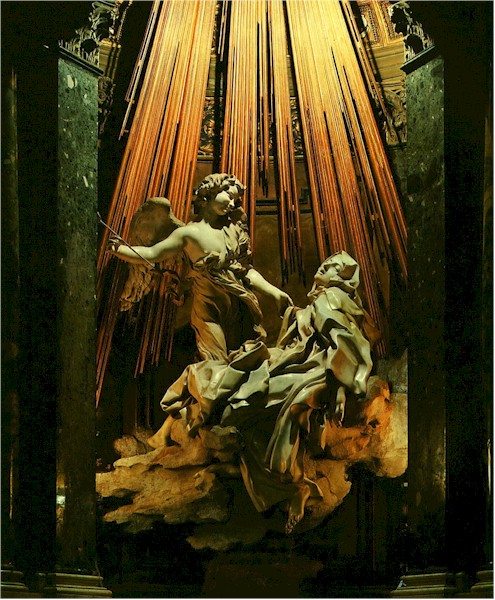
Ever since watching a programme about it last Friday, I can't stop thinking about Gianlorenzo Bernini and his sculpture The Ecstasy Of St Theresa. I feel haunted. In the most transient moments - sipping a cup of tea, throwing a bag over my shoulder to go out the door, turning over in my bed in the early morning, slicing potatoes on my plate, I see the image of St Theresa's enraptured face, turned upwards, her mouth open, the fine point of an arrow entering her, a spray of golden light behind, her robe in swathes around her like liquid sunshine.

It is almost a cliche now to talk of the greatest art as being created by the most messed up people. And true, there is much powerful art that is, and has, been created by men and women where neither mental illness nor egomania is the driving force. But equally as true, genius springs from what is incomplete, flawed, sordid, neurotic, stupid, disparate and ugly. From the gutters of despair, in the midst of crashing disillusion, loss, sorrow, hatred and violence (I wonder if life itself is only as beautiful as its own despair, only as pure as its worst filth, only as strong as the weakest, most despised runt of the litter).

I think of this when I look at the Ecstasy Of St Theresa, and when I remember Bernini's torrid life story, and his dramatic depiction of this woman, a holy woman, and, in particular, of her physicality, her face and body as the meeting place or conduit for divine revelation and bliss.

I think a woman's body, in all its variations, is to me one of the most beautiful forms there is on this planet. It is one which has been, and still is the site of devotion, adoration, violation, reverence, contempt and horror in our world. Exalted, degraded, ridiculed, feared, controlled, desired in a million different ways, a woman's body is as complex as life itself, as death, as dying, as growth and decay, as desire, wanting and repugnance.

Sitting here now, under my clothes, I can feel the skin of this body that I breathe through, I can sense the blood circulating my veins, hear my heart beating in my ear if I press it to my shoulder. My breasts, my hips and vagina, my neck, legs, skin, hair, eyes, buttocks, feet, my back are all realities in and of themselves, but they're also the vehicle for a thousand different projections, some dazzling, some shimmering, some comforting, some lit up in the crudest red light or beset by howling laughter.

Some of these have been handed down to me through time, some are of my era, some through art, through philosophy, religion, culture, literature. Some are inside my own head, most surround me from the outside, from the voices of men, from the voices of women talking to men, from the voices of women who do not care what men have to say. From my mother, from my father.

Am I ever my own woman, I ask myself, can I ever escape this hall of mirrors, know my body beyond its own symbols?

I think of it split and ripped by giving birth, a cell multiplying inside it, growing into foetus, forming, enlarging, holding the blueprint for its own destiny, forming hands and feet, a nose, a throat. A life being born - my body as toil, violent music playing through a crackling stereo. A child moving through me, pushed out by labour and agony through the birth canal, ripped from my flesh, out into cold open air. The uncut umbilical cord, the bloody placenta.

Inside and through this female body, life is formed and grown and expelled with massive effort and incredible physical, mental and emotional intensity. And this intensity, this force and power is there, whether realised or not, in every single woman as part of her physical being.

To me, this force inside a woman is beautiful, and messy. It is complex and it is also the simplest force in the world. A force not different from that of the uncovered grave, a corpse peeping out at us from under the soil. Or from a puja on the Ganges, in a blazing light of candles. Or the baby floating past, its head, a bloated shrine. Its skin, grey.

And yes, it is The Ecstasy Of St Theresa, hovering in the air. But it is also Bernini, the artist who carved it, a year before its conception, sunk to the floor, a nobody, a nothing, the memory of the failure of his greatest architectural ambition ringing in his ears.

As it is the epilieptic nun, scissoring in divine rapture across the wooden floor, eyes rolling in the back of her head. She is not pretty. She is not even beautiful. Only a coarse woollen robe, two pairs of old hands holding her spindled tattered frame in the sunlight that pours through the stained convent windows, too bright to bear without her palm across her face.

And this same force is also Bernini's illicit lover, Constanza, in marble, the loop of her cotton blouse pulled slightly undone, her eyes like wildfire in a forest at night, or a tiger esaped from the zoo, once leashed and captive, now, more than untamed: out of control, hunting, hunting down.

And it is Bernini's servant with a sword, slashing at Constanza's face in retribution until it is ribbons, the pillow soaked in her blood, the colour of her most beautiful dress, of her lust. She will never again have a face that can be immortalised in sculpture. The Muse becomes damaged goods, fallen from ecstatic grace, imprisoned for fornication, disfigured.

So it is Constanza who pays the greatest price for passion, and after nearly killing his own brother and scarring her face for life, the real perpetrator goes free: Bernini, the great hero of Rome becomes an even greater hero, the great hypocrite, scoundrel, egomaniacal amour, liar, destroys and violates in the name of love all that he once created and revered as beautiful, as divine. This woman who was his Muse, who became marble, who fired one of the greatest sculptors in history's world with a blaze of signifiers. Who torched it all with her own betrayal. Whom he will never want again. Whom he will never again watch sleeping through the night, holding his breath lightly so as not to wake her. Whom he will never long to press her small head into his chest as though she were his own restless child.

And now her face is a map of stars, all traced in blood, her honour a withered flower, her wildfire burnt out beyond all reason. Where is left for the woman to go? At Bernini's command she is again caged, this time in a damp prison cell without light, in rags and humiliation, taught the lesson that all women who play with fire must learn in 17th century civilisation, the image of her passion, her beauty, her womanhood, consigned to a sunless locked vault.

This same man conceived and gave birth to the remarkable, transcendent Ecstasy Of St Theresa, long after the light had left his eye, long after such tragedy and violence, after his own sudden descent into failure and his turning to God. And this same woman, Constanza, also gave birth to it, and is enfolded within the creases of St Theresa's robes, in the openness of her mouth, her half closed eyes, though almost certainly neither she or Bernini will have ever known, will ever know this.

Woman, Muse, sister, daughter, mother, virgin, slut, truth, beauty, warfare, corruption, fertility, deceit, the earth, the stars, the moon, the fields, the tether, the breaking of all mundane bonds, the higher, the lower, animal, angel, divinity, a flower, a rose, the scent of death...these words and images haunt me, as the Ecstasy Of St Theresa haunts me, as Constanza and the nun haunt me, as a woman who, like every other woman, is all of these things, who is Constanza and St Theresa, Bernini and the ecstasy itself, and, who, in the middle of the night, or when sipping tea, or throwing a bag over her shoulder to go out of the door, slicing potatoes, is none of them, never has been, and never will.


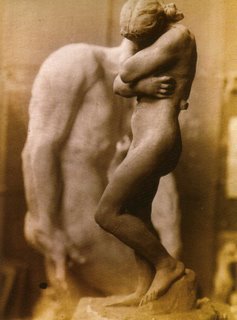
(top image: 'Eve', Rodin's studio, 'Cain' in background.)